
 Live Science Plus





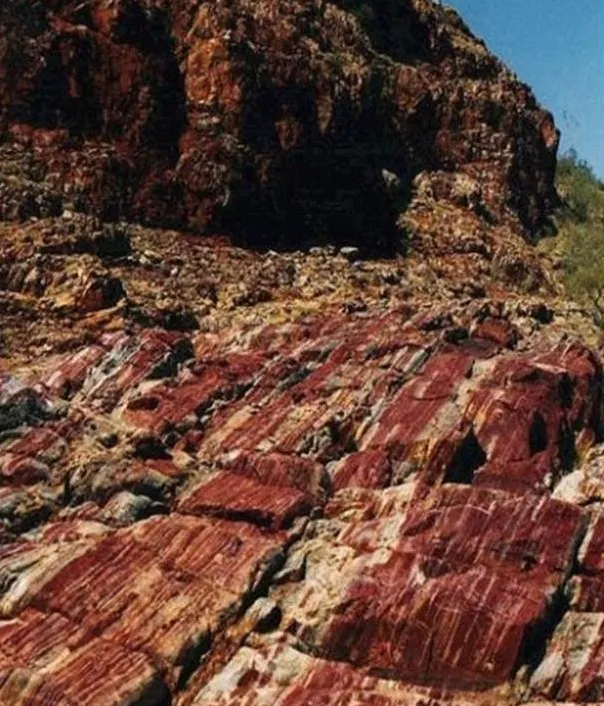
Three and a half billion years ago, a mega asteroid slammed into Earth, triggering massive tsunamis and leaving craters bigger than many U.S. states. It was the second oldest and one of the largest impacts known to have hit the planet.
Now, for the first time, remnants of that impact have been uncovered in ancient sediments in Australia, and they're revealing more intriguing details about the Earth at that time.
Article continues below
"The impact would have triggered earthquakes orders of magnitude greater than terrestrial earthquakes; it would have caused huge tsunamis and would have made cliffs crumble," study co-author Andrew Glikson, a planetary scientist at the Australian National University, said in a statement.
The massive impact vaporized the asteroid instantly, forming tiny, spherical glass particles known as spherules that were flung around the world.
"Material from the impact would have spread worldwide," Glikson said. "These spherules were found in seafloor sediments that date from 3.46 billion years ago."
Ancient rocks, early Earth history
The evidence of the ancient mega-collision was unearthed in a rock formation known as the Marble Bar, in northwestern Australia. The sediments are roughly 3.5 billion years old and create a fuzzy snapshot of what early Earth was like during the Archean eon, roughly 4 billion to 2.8 billion years ago.
The evidence of the impact was unearthed in a portion of the sediments that originated on the ocean floor. These ocean sediments were then preserved between two layers of volcanic sediments that could be dated with a high degree of precision, allowing the scientists to determine exactly when the impact occurred. While glass spherules are often a sign of an impact, the team found that the levels of platinum, chromium and nickel found in the spherules were very similar to those found inside asteroids.
Early in the solar system's history, about 3.9 billion years ago, similar monster rocks bombarded the moon, pockmarking its surface with craters called mare that are still visible today. However, on Earth's surface, the constant circulation of magma and the recycling of continental and oceanic crust have wiped away most traces of similar impacts, the researchers said.
"This is just the tip of the iceberg; we've only found evidence for 17 impacts older than 2.5 billion years, but there could have been hundreds," Glikson said. "Asteroid strikes this big result in major tectonic shifts and extensive magma flows. They could have significantly affected the way the Earth evolved."
The findings will be published in the July issue of the journal Precambrian Research.
Follow Tia Ghose on Twitter and Google+. Follow Live Science @livescience, Facebook & Google+. Original article on Live Science.

