













Magic of Rembrandt's Painting Technique Revealed

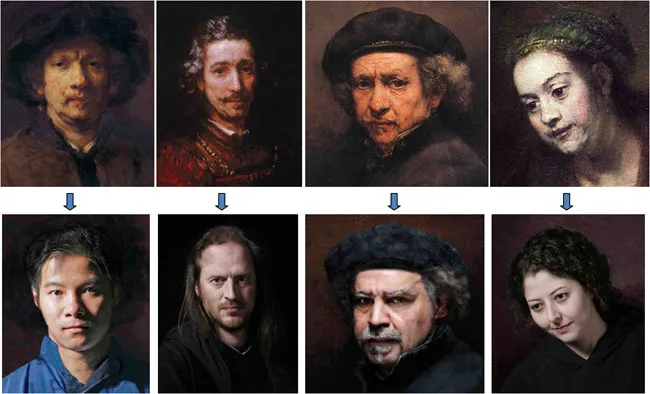
Rembrandt's paintings have transfixed viewers for centuries, but now a new study reveals a scientific explanation for their calming beauty. By painting more detail in and around the eyes of his subjects, Rembrandt tapped into an innate human attraction to the face. This creates a more calming and immersive experience for the viewer.
Steve DiPaola of the University of British Columbia (UBC) suggests Rembrandt Harmenszoon van Rijn may have pioneered a technique that guides the viewer's gaze around a portrait, creating a special narrative and "calmer" viewing experience. He and his colleagues detail their findings in the current issue of the Massachusetts Institute of Technology's arts and sciences journal Leonardo.
Renaissance artists used various techniques to engage viewers, many incorporating new scientific knowledge on lighting, spatial layout and perspectives. To isolate and pinpoint factors that contribute to the "magic" of Rembrandt's portraits, DiPaola used computer-rendering programs to recreate four of the artist's most famous portraits from photographs of himself and other models. Replicating Rembrandt's techniques, DiPaola placed a sharper focus on specific areas of the model's face, such as the eyes.
Working with a team from the Vision Lab in UBC's Department of Psychology, DiPaola then tracked viewers' eye movements while they examined the original photographs and the Rembrandt-like portraits.
"When viewing the Rembrandt-like portraits, viewers fixated on the detailed eye faster and stayed there for longer periods of time, resulting in calmer eye movements," DiPaola said. "The transition from sharp to blurry edges, known as 'lost and found edges,' also directed the viewers' eyes around the portrait in a sort of narrative."
The study is the first to scientifically verify the impact of these "eye-guiding" techniques on viewers and to attribute its origin to Rembrandt.
The viewers also preferred portraits with this "eye-guiding narrative" to the original photographs with uniform details across the tableau.
Get the world’s most fascinating discoveries delivered straight to your inbox.
"Whether he observed how his own eyes behaved while viewing a painting or if he did it by intuition, Rembrandt incorporated an understanding of how the human eye works that has since been proven accurate," DiPaola said.
