Monkey Drumming Suggests the Origin of Music

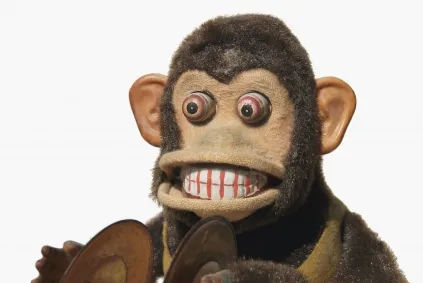
When monkeys drum, they activate brain networks linked with communication, new findings that suggest a common origin of primate vocal and nonvocal communication systems and shed light on the origins of language and music.
In the wild, monkeys known as macaques drum by shaking branches or thumping on dead logs. Similar behavior has been seen in non-human primates — for instance, gorillas beat their chests and clap their hands, while chimpanzees drum on tree buttresses.
In the lab, scientists noted that rhesus macaque monkeys drummed using artificial objects such as cage doors by shaking them vigorously or slapping or banging them against surfaces, often with accompanying threatening sounds, postures and facial expressions. Only the largest and dominant monkeys drummed, suggesting that drumming was used to communicate messages about power and status — the louder the drumming, the bigger and stronger the macaque likely is.
Inside the mind
Past research had uncovered areas of the brain linked with vocal communication in monkeys, findings that hint at the roots of vocal communications in primates. The discovery of drumming in rhesus macaques offers a way to examine what brain regions were linked with nonvocal communication, such as music in humans. [Humans and macaques are thought to have had a common ancestor about 25 million years ago.]
Investigators at the Max Planck Institute for Biological Cybernetics in Tübingen, Germany, scanned monkey brains while the rhesus macaques listened to either drumming or monkey calls. They found overlapping networks activated in the temporal lobe, which in humans is key to processing meaning in both speech and vision.
"Monkeys respond to drumming sounds as they would to vocalizations," researcher Christoph Kayser, a neuroscientist at the Max Planck Institute for Biological Cybernetics in Tübingen, Germany, told LiveScience. "Hence, drumming originated as a form of expression or communication, possibly in an ancestral species common to apes and old-world monkeys, early during primate evolution."
Get the world’s most fascinating discoveries delivered straight to your inbox.
Roots of music
The researchers suggest primate drumming might represent a precursor of musical abilities in humans.
"Humans convey information not only using speech, but also using other sounds that range in diversity from loud hand-clapping as applause, to the discrete knocking on a door before entering, to drumming that forms an important part of music," Kayser noted. "What is common between such sounds is that they are produced by repeated movements of the limbs so as to produce a structured sound made up of a series of periodic repeats, or beats. Humans use very complicated beat patterns by drumming, often in conjunction with musical rhythms. It is well known that such percussive beat generation is ubiquitous across human cultures, even used by tribal cultures."
The fact that vocal and nonvocal communication have common origins in the brain in monkeys could support the notion that both co-evolved "to support the human faculties of language and music," he added. "This also provides evolutionary support for the gestural theory of communication, which proposes that human speech and language developed from gestures and hand actions. We provide the functional link between gestural communication and vocal communication by identifying brain areas activated by sounds associated with gestures and vocalizations."
The scientists detailed their findings online September 28 in the Proceedings of the National Academy of Sciences.
- Top 10 Amazing Animal Abilities
- Video: Babies Learn Music Easier Than Adults
- Case Closed: Apes Got Culture