













Huge Dinosaur Tooth Found in Spain

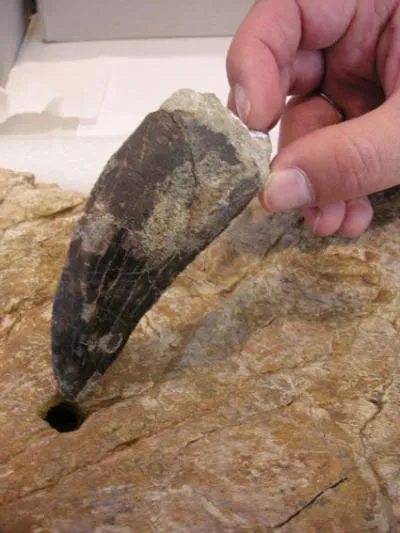
An allosaurid tooth as long as a tall man's finger has been found in Spain, a researcher said, making it the largest tooth of a carnivorous dinosaur ever found in that country.
Allosauridae, a family of dinosaurs that includes Allosaurus, were predatory, bipedal theropod dinosaurs that lived in the late Jurassic Period, 155 million to 145 million years ago. They had dozens of sharp teeth and huge skulls.
Local residents found the 3.8 inch-long (9.8 centimeters) tooth in deposits in Riodeva, Teruel.
"Given the great variations between the teeth of different kinds of allosaurids, it would be prudent for us to assign this fossil to an indeterminate Allosauroidea," said researcher Luis Alcalá, managing director of the Teruel-Dinópolis Joint Palaeontology Foundation. The research is set to be published in an upcoming issue of the journal Estudios Geológicos, according to SINC, the Spanish Foundation for Science and Technology.
The tooth has been compared with other allosaurid samples found in the Iberian Peninsula — in particular with a large tooth from Portugal (measuring 5 inches, or 12.7 centimeters, long) and another belonging to an allosaurid in Spain, until now described as the largest in Spain at 3.2 inches (8.27 centimeters).
A complete faunal record of Riodeva
Numerous dinosaurs have been described based on fossils found in the Villar del Arzobispo Formation in Riodeva, Alcalá said.
Get the world’s most fascinating discoveries delivered straight to your inbox.
Plant-eating dinosaur groups discovered in the deposit to date have been identified, based on tooth remains and a complete rear leg, as sauropods, stegosaurids and basal ornithopods.
"Now the carnivorous dinosaurs are also represented, at least by two medium-sized theropods and a large predator belonging to the Allosauroidea clade [group]," Alcalá said.
Carnivorous dinosaurs grew new teeth over their lifetimes, which increases the likelihood of finding their fossils today.
In this case, the condition of the crown of the tooth — it lacked any reabsorption surfaces — indicates that it was not a discarded tooth. Therefore, the paleontologists hope to discover the remains of this large predator, which could have attacked Turiasaurus riodevensis, a sauropod dinosaur also known as "the European giant."
