













New Device Disables Digital Cameras

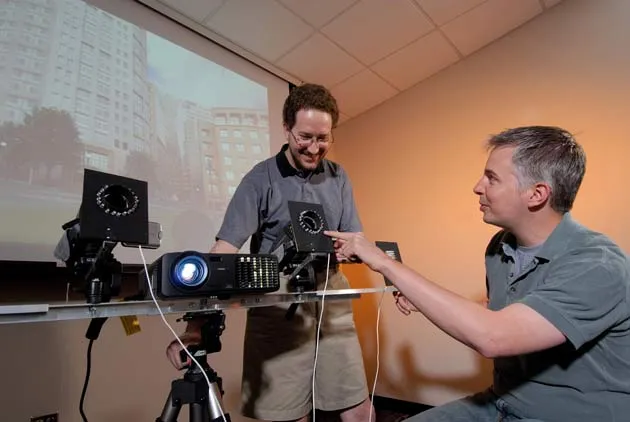
Researchers have built a prototype device that disables digital cameras. Future versions might thwart unwanted photo-taking at a specific location and even prevent clandestine videos from being made.
The technology might one day prevent espionage in a building or stop pirating of movies from theaters.
It could even be used to stop Mom from taking pictures of her child with Santa to avoid paying for the professional shot.
The device uses sensors, lighting equipment, a projector and a computer to scan for, find and neutralize digital cameras. It looks for the reflectivity and shape of the image-producing sensors used in digital cameras. Future versions might operate in the invisible infrared range so the neutralizing technology would work unnoticed.
“We're at a point right now where the prototype we have developed could lead to products for markets that have a small, critical area to protect,” said project leader Gregory Abowd of Georgia Institute of Technology. “Then we’re also looking to do additional research that could increase the protected area for one of our more interesting clients, the motion picture industry.”
The technology might work particularly well in a theater. Digital video cameras use a reflective CCD device that sends light back to its origin rather than scattering it. That would make them easy to detect.
“Movie piracy is a $3 billion-a-year problem,” said James Clawson, a research technician on the project. “If someone videotapes a movie in a theater and then puts it up on the web that night or burns half a million copies to sell on the street—then the movie industry has lost a lot of in-theater revenue.”
Get the world’s most fascinating discoveries delivered straight to your inbox.
A computer is used to determine what the device sees.
“The biggest problem is making sure we don’t get false positives from, say, a large shiny earring,” said team member Jay Summet. “We need to make our system work well enough so that it can find a dot, then test to see if it's reflective, then see if it's retroreflective, and then test to see if it's the right shape.”
Once a CCD is found, a thin beam of white light is shined on it, rendering the recording unuseable.
- Science Image Galleries
- Military Sensor Hears Through Walls
- DVR Would Turn Off When Viewer Falls Asleep
- CVS to Sell Disposable Video Cameras
- Science Videos
