













Fluorescent-Red Glowing Fish Found
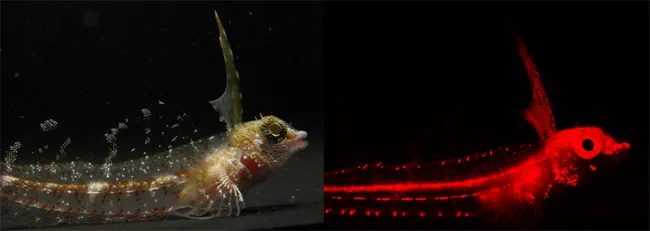
Dr. Seuss had it right with "One fish, two fish, red fish, blue fish." Only put the emphasis on red.
Scientists have found that red is a favorite color among some fish and have discovered several that actually fluoresce in the vibrant hue.
Until now, many researchers had considered the color red way out of fashion in the underwater realm, where red wavelengths of sunlight are immediately absorbed by seawater near the surface, said Nico Michiels of the University of Tübingen, Germany, who led a team that discovered the red fish.
That means objects that look red in air or in shallow water appear grey or black at depths below about 33 feet (10 meters). Unlike red, blue-green light penetrates deeper and is the reason our oceans appear blue. But fish have found their own way to red.
The new results, which will be published in an upcoming issue of the journal BMC Ecology, show "that red fluorescence is widespread among marine fish," Michiels said.
Michiels discovered the glowing-red fish by chance during dives in Mangrove Bay in the Red Sea (the salt water inlet between Africa and the Arabian Peninsula), where he was investigating how deeply red light penetrates into the water. Wearing goggles that enabled him to only see red light, Michiels was struck by blobs of red which ringed the eyes of several fish, adorned the entire bodies of others or coated a single fin.
"The most striking ones had red fluorescence around the eyes and one where its whole body seemed to glow," he said.
Get the world’s most fascinating discoveries delivered straight to your inbox.
The red glow is likely a form of private communication or an attraction signal, Michiels said, though he doesn't have clear proof yet. Because the light is coming from the fish themselves and not filtering down from the surface, the red glow remains visible at depth and is easily seen at close distances only.
"We are convinced that we are the first ones to discover it [red fluorescence in fish] in the field and to recognize it as such an important phenomenon in reef fish," Michiels told LiveScience.
Many fish species have shown their abilities to fluoresce in blue and green. And in 2005, a relative of the jellyfish was identified as fluorescing in red light. (Despite the name, jellyfish are not actually fish.)
Fluorescence occurs when light is absorbed at one wavelength and then re-emitted at another nearly immediately. In the case of the red fluorescence, these fish absorb light at blue-green wavelengths and re-emit it at red.
Michiels speculates red fluorescence is a widespread phenomenon in reef and other fish. Since the initial discovery, he has identified other such light-emitters in the Mediterranean.
- Video: Bioluminescent Squid Attacks Rig Line
- Vote Now: The World's Ugliest Animals
- Image Gallery: Freaky Fish
Jeanna Bryner is managing editor of Scientific American. Previously she was editor in chief of Live Science and, prior to that, an editor at Scholastic's Science World magazine. Bryner has an English degree from Salisbury University, a master's degree in biogeochemistry and environmental sciences from the University of Maryland and a graduate science journalism degree from New York University. She has worked as a biologist in Florida, where she monitored wetlands and did field surveys for endangered species, including the gorgeous Florida Scrub Jay. She also received an ocean sciences journalism fellowship from the Woods Hole Oceanographic Institution. She is a firm believer that science is for everyone and that just about everything can be viewed through the lens of science.