













Antarctica Losing Ice, Contrary to Expectations

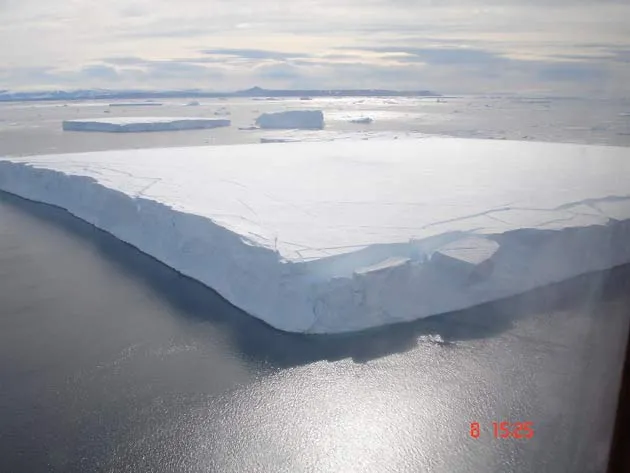
Joining the growing list of places on this planet that are melting, Antarctica is losing some 36 cubic miles of ice every year, scientists said today.
For comparison, Los Angeles consumes roughly 1 cubic mile of fresh water a year.
The south polar region holds 90 percent of Earth’s ice and 70 percent of the total fresh water on the planet, so any significant pace of melting there is important and could contribute to an already rising sea.
"This is the first study to indicate the total mass balance of the Antarctic ice sheet is in significant decline," said Isabella Velicogna of the University of Colorado at Boulder.
The study is detailed today in the online version of the journal Science.
Other studies have documented rapid melting, unprecedented in modern times, in Greenland and around the North Pole. And rapid melting of individual glaciers has been noted in Antarctica.
For now, the newly measured melting might seem like a small quantity. The loss of ice in Antarctica amounts to about 0.4 millimeters of global sea rise annually, with a margin of error of 0.2 millimeters, the study concludes. There are about 25 millimeters in an inch.
Get the world’s most fascinating discoveries delivered straight to your inbox.
However, computer models run in 2001 predicted Antarctica would gain ice during the 21st century due to increased precipitation in a warming climate. But the new study, based on satellite measurements between 2002 and 2005, shows the opposite.
Antarctica is twice as large as Australia. The ice sheet, which covers about 98 percent of the continent, has an average thickness of about 6,500 feet—more than a mile.
- Effects of Global Warming: Allergies Get Worse
- Conflicting Claims on Global Warming and Why It's All Moot
- Baffled Scientists Say Less Sunlight Reaching Earth
- Scientists Clueless over Sun's Effect on Earth
- Animals Change Behavior as Planet Warms
Hot Topic
The Controversy
- Conflicting Claims on Global Warming and Why It's All Moot
- Baffled Scientists Say Less Sunlight Reaching Earth
- Scientists Clueless over Sun's Effect on Earth
- Key Argument for Global Warming Critics Evaporates
The Effects
- Greenland Melts
- Ground Collapses
- Allergies Get Worse
- Rivers Melt Sooner in Spring
- Increased Plant Production
- Animals Change Behavior
- Hurricanes Get Stronger
- Lakes Disappear
- Seas Rise
The Possibilities
- More Rain but Less Water
- Ice-Free Arctic Summers
- Overwhelmed Storm Drains
- Worst Mass Extinction Ever
- A Chilled Planet
Strange Solutions

Robert is an independent health and science journalist and writer based in Phoenix, Arizona. He is a former editor-in-chief of Live Science with over 20 years of experience as a reporter and editor. He has worked on websites such as Space.com and Tom's Guide, and is a contributor on Medium, covering how we age and how to optimize the mind and body through time. He has a journalism degree from Humboldt State University in California.