













Scientists Make Water Run Uphill
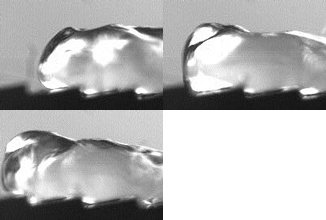
Toss water on a hot pan and it sizzles and evaporates. Toss water on a really hot pan, and the water beads up and starts roaming around.
Now, turn your hot pan into a hot small staircase and watch the water climb the stairs.
Researchers did just that, taking an everyday sighting in the kitchen to a new level in the lab.
How it works
If a pan's really hot, the water starts to evaporate before it even touches the surface. The evaporating water, in the airy form of a water-vapor cushion, holds the droplet above the pan. With moves as smooth as Fred Astaire, the droplet glides around on air.
When scientists heated a piece of brass with saw-tooth ridges—a thing that looks like a ratchet—water drops traveled quickly and in one direction: up.
[See the video. Credit:
Get the world’s most fascinating discoveries delivered straight to your inbox.
"The drop rides along on the vapor like a boat on a river," said physicist Heiner Linke from the University of Oregon. "The vapor is generated between the droplet and the ratchet's surface in a narrow gap, about the width of a human hair. The vapor needs a way to get out of there, and it's going to take the easiest way out. There's always going to be one direction in which it's easier to get out."
The escaping vapor pulls the droplet along in the same direction.
The research is scheduled to be published in the April 14 issue of the journal Physical Review Letters.
Potential use
The traveling drops could prove helpful in cases where scientists need to cool something down with water or another liquid. Tiny air conditioners are used to cook microchips in laptop computers. But the cooling system itself requires extra energy, which creates more heat.
With the newfound trick, drops could potentially pump themselves, using heat that's already there. "Pumps that don't use moving parts are simpler to make, cheaper and live longer," Linke pointed out.
If the droplet pumps prove strong enough, Linke said they could be cooling computers in about six years.
In the meantime, schoolteachers have a new trick for the classroom.