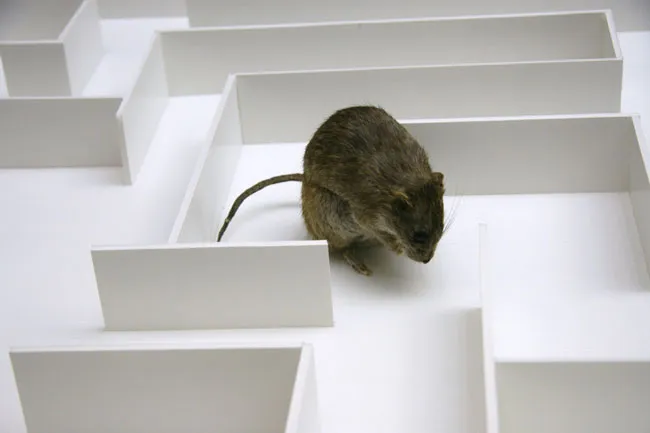
Baby rats have an innate sense of direction in place even before they take their first steps out of the nest, a new study found.
The discovery that rats have a hardwired navigation system could also have implications for human brain development.
Researchers implanted electrodes into the brains of newborn rats in the spots known to control mapping and direction. These areas are known from research done on adult rats, but this was the first time scientists have looked at these neural systems in such young animals.
Latest Videos From
Each neuron communicates with other neurons using electrical signals that are measured by the implanted electrodes. The researchers were surprised to detect activity in the neurons responsible for a sense of direction from the very beginning.
"The rats are so young they haven’t had experience beyond the nest, which is so small they can't walk in it," said researcher Francesca Cacucci of the University College London Institute of Behavioural Neuroscience. "The signals are there from the very first time. We assume that these must have been hardwired before."
The scientists were able to differentiate between the three main aspects of the brain's mapping system: the sense of location, the sense of direction, and the sense of distance.
They found that the directional neurons were active first, sending out clear and mature signals when the pups were first born.
The location cells, which tell the animal its current position, were fuzzy at first and became more precise over a period of days.
Finally the distance neurons, which establish how far away things are, came last, when the rats were around 21 days old. At this point all the pieces of the puzzle came together, Cacucci said, and the rats were able to do things like navigate a maze.
Though a similar study would be impossible in humans, because the electrodes are too invasive to implant in babies, the researchers think their findings could suggest that a sense of direction is innate in humans, too.
"The milestones that human infants go through are very much like the ones that young rats go through," Cacucci told LiveScience. "We can extrapolate to some extent and we can assume these cells are doing something in the human brain as well."
The scientists measured no differences between individual rats, so they don't know at this point why some individuals seem to have a better sense of direction than others. The study only included male rat pups, too, so the researchers can't say whether there would be any sex difference at this stage, though Cacucci said she doubts it.
The research is detailed in the June 18 issue of the journal Science.