













The Faults That Ruptured in Twin California Quakes Are Very, Very Weird, Geologists Say.
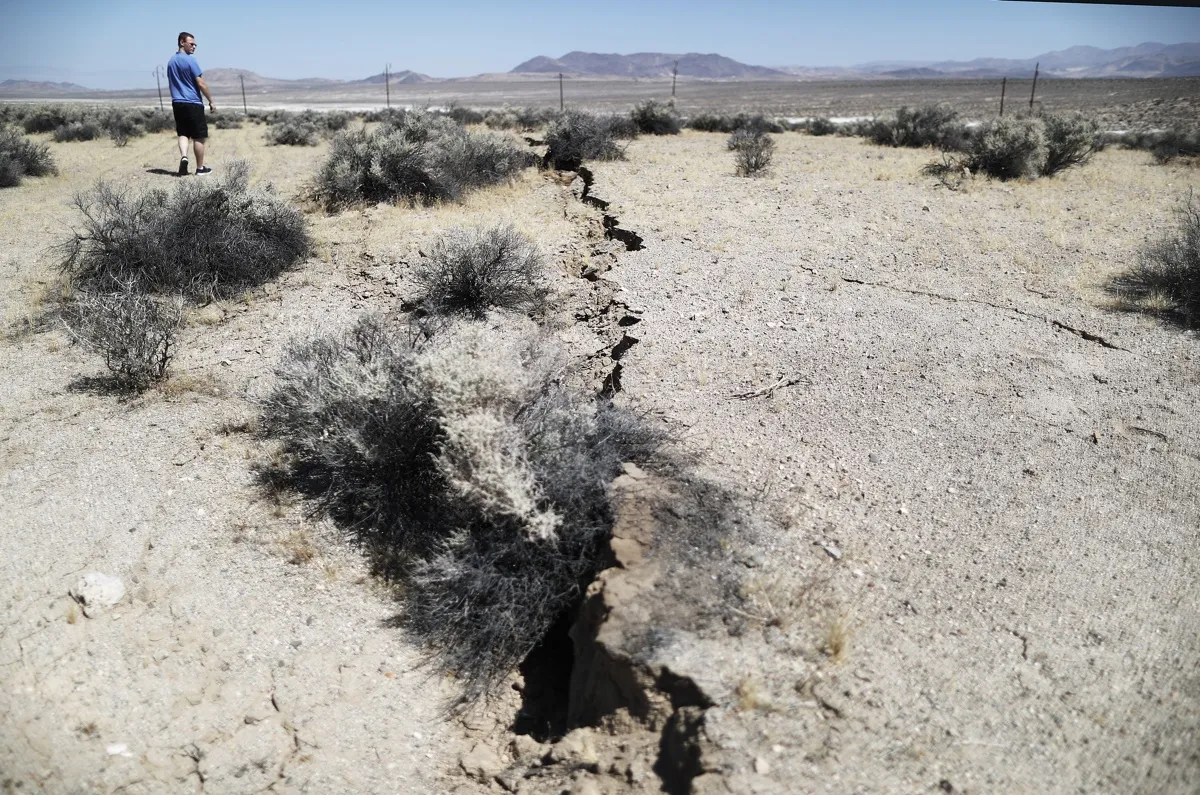
On July Fourth, the most powerful earthquake to hit Southern California in nearly 20 years struck a remote part of the Mojave Desert. A day later, an even larger temblor rocked the same area.
Though earthquakes beget earthquakes, there's generally thought to be just a 5% chance that one quake will be followed by an even more powerful one, according to geoscientists. But that wasn't the only unusual feature of this earthquake duo in SoCal. Turns out, the earthquakes ripped Earth in weird ways.
In particular, the temblors occurred on perpendicular faults in a zone known to be pretty complicated. [Northridge Earthquake: 20th Anniversary in Photos]
Buried faults
The magnitude-6.4 temblor struck the sparsely populated SoCal area at 10:33 a.m. local time on July 4, about 122 miles (196 kilometers) north-northeast of Los Angeles and just 11 miles (18 km) east-northeast of Ridgecrest. That quake was followed by several aftershocks, according to the U.S. Geological Survey (USGS).
Scientists warned that a powerful aftershock of the same magnitude or greater was a possibility. Just a day later, at 8:19 p.m. local time, a quake of magnitude 7.1 — which is 11 times more powerful than the July Fourth event — struck about 6.8 miles (11 km) northwest of its predecessor.
The network of cracks in Earth's crust where the quakes occurred sits within the North American plate, which bumps up against the northwesterly moving Pacific plate. [In Photos: The Great San Francisco Earthquake]
"The earthquakes of the 4th and 5th occurred in what we call a fault zone," Glenn Biasi, a geophysicist with the USGS in Pasadena, California, told Live Science in an email, "where many individual faults are active. Many are short, and because they are buried, we probably do not know them all." He added, "This area does not fit the textbook picture of sides of a plate sliding past one another," and instead the relatively short faults criss-cross each other on more than one plane. (In fact, the 6.4-magnitude quake began at a depth of 6.6 miles, or 10.7 km, while the epicenter of the bigger quake was much deeper, some 10.6 miles, or 17 km, beneath the surface.)
Get the world’s most fascinating discoveries delivered straight to your inbox.
Susanne Jänecke, a geoscientist at Utah State University, described these fault systems as "hanging shoe organizers," where the sides, and tops and bottoms of the organizer would represent the various faults.
Right-angle ruptures
Here's where things get interesting: The 7.1-magnitude earthquake rattled a fault within the Little Lake fault zone — cracks in this spot near Ridgecrest tend to run in the northwest-southeast direction.
"The earthquake on Thursday [July 4] was more complex. And part of that smaller event happened on an unmapped fault that trends NE-SW. This is very interesting geologically, said Michele Cooke, a geoscientist at the University of Massachusetts - Amherst. "We don't have a lot of earthquakes in our record that show simultaneous slip on two perpendicular faults."
Even so, Cooke said many recent earthquakes have been a little messy, rupturing in a more complicated way than just an even slip on a single plane of faults. "Many of us are wondering if these complications are actually the norm and that our instruments 10+ years ago were not sensitive enough to pick up these complications," Cooke told Live Science in an email.
Such complex rupturing is dangerous.
"This increases the challenge for seismic hazard forecasting because complex ruptures happen across multiple faults and impact wider regions," Cooke added.
These two earthquakes could also be just another sign that more seismological action is starting to occur not along the infamous San Andreas Fault but rather in the so-called Eastern California Shear Zone (ECSZ). "I'm not yet convinced of this, but I do think that this recent (geologically speaking) cluster of earthquakes in the ECSZ is very interesting," wrote Cooke, referring to 1992 and 1999 earthquakes within the zone.
So what's next? Is there more stress that needs to be released along these complicated faults, or should Californians rest easy?
"Without a doubt the earthquakes released stress on the fault. The more challenging question is whether these earthquakes loaded up nearby faults and whether 'enough' of the stress has been released," Cooke said.
- The 10 Biggest Earthquakes in History
- Image Gallery: This Millennium's Destructive Earthquakes
- Photo Journal: The Gorgeous San Andreas Fault
Originally published on Live Science.
Jeanna Bryner is managing editor of Scientific American. Previously she was editor in chief of Live Science and, prior to that, an editor at Scholastic's Science World magazine. Bryner has an English degree from Salisbury University, a master's degree in biogeochemistry and environmental sciences from the University of Maryland and a graduate science journalism degree from New York University. She has worked as a biologist in Florida, where she monitored wetlands and did field surveys for endangered species, including the gorgeous Florida Scrub Jay. She also received an ocean sciences journalism fellowship from the Woods Hole Oceanographic Institution. She is a firm believer that science is for everyone and that just about everything can be viewed through the lens of science.