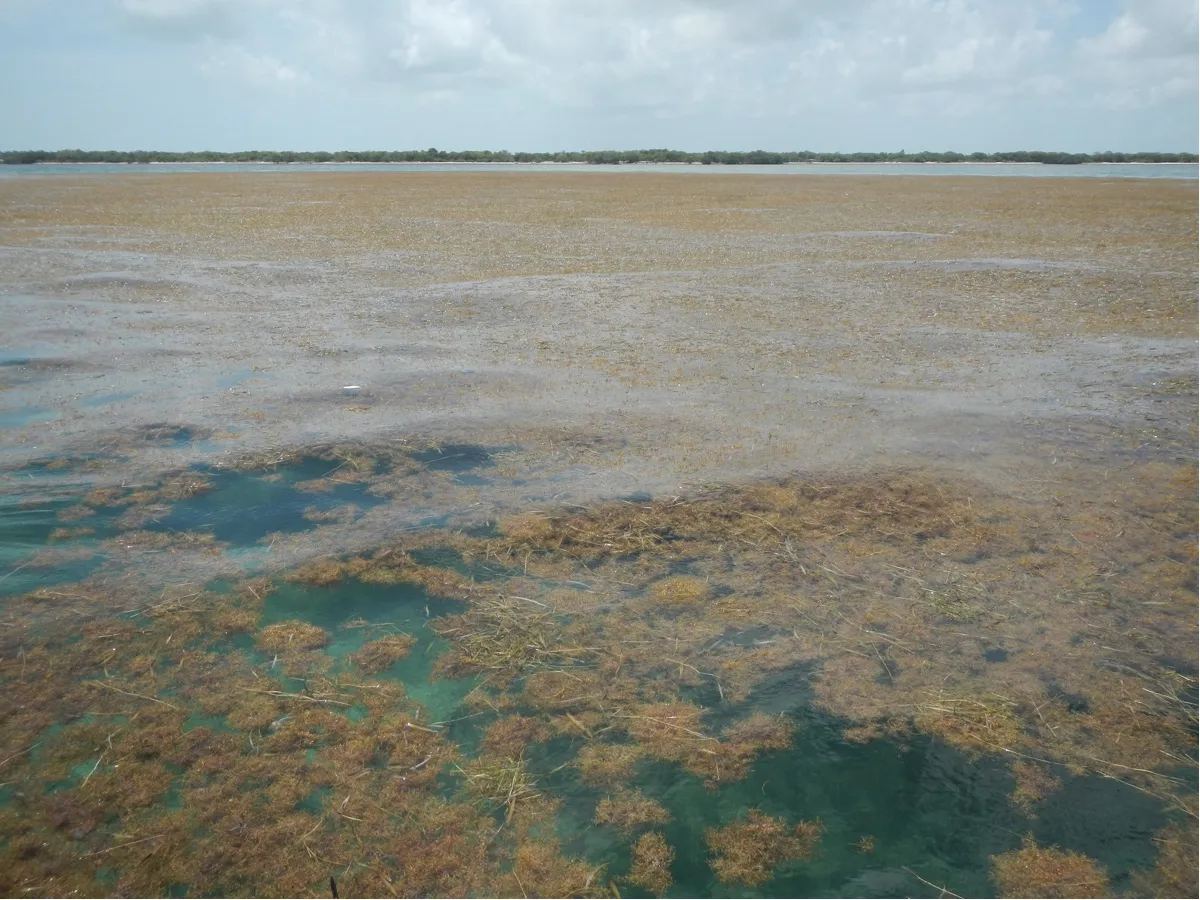
For eight years, thick mats of seaweed have smothered coral reefs, trapped sea turtles and brought economic instability to coastal communities as reddish-brown gobs of foul-smelling sargassum wash onto beaches along the Caribbean Sea, Gulf of Mexico and tropical Atlantic.
These phenomena are symptoms of a massive seaweed bloom scientists are calling the Great Atlantic Sargassum Belt. Researchers describe the belt and explore its causes in a study published July 4 in the journal Science.
Stretching up to 5,500 miles (8,850 kilometers) from the Gulf of Mexico to just off the coast of western Africa, the Great Atlantic Sargassum Belt appears to be the product of natural and human-caused factors.
"We analyzed almost 20 years of satellite records," Mengqiu Wang, a postdoctoral researcher at the University of South Florida and co-author on the study, told Live Science. [Earth from Above: 101 Stunning Images from Orbit]
The researchers analyzed a dataset that predates the belt's first appearance in 2011, allowing them to investigate the long-term environmental changes that set the stage for the year-to-year variations in the growth of the bloom.
They identified a tipping point around 2009 when discharge from the Amazon River brought unusually high levels of nutrients into the Atlantic Ocean. Upwelling of nutrient-rich water off the west coast of Africa in the winter of 2010 further enriched surface waters with deep-sea nutrients; that upwelling also lowered temperatures of that surface water, allowing sargassum to thrive in the summer of 2011.
A similar combination of factors led to especially large blooms in 2014, 2015 and 2017. The largest recorded bloom occurred in 2018, when the Great Atlantic Sargassum Belt grew to a mass of more than 20 million metric tons. The high levels of nutrients from the Amazon River come from deforestation and fertilizer use in the Amazon basin.
Sign up for the Live Science daily newsletter now
Get the world’s most fascinating discoveries delivered straight to your inbox.
Under normal circumstances, sargassum provides critical habitat for marine life. The seaweed oases attract fish, birds and sea turtles as well. Dolphins and sea turtles also benefit from the tiny patches of life floating in the open ocean, but thick mats of sargassum pose big problems for some wildlife and coastal communities.
Mengqiu Wang was performing field work in the Gulf of Mexico last year when she saw dolphins seeming to enjoy their foray through the Sargassum.
(Image credit: University of South Florida)
"As sargassum decays it consumes the oxygen, creating low oxygen conditions, which is not a good condition for marine life in a coastal ecosystem," Wang said. Coral reefs and seagrass ecosystems can suffer when high levels of sargassum change water chemistry and block organisms from moving freely.
"Sea turtles sometimes can't swim through the dense mats to return to open water after laying their eggs," she said.
The Great Atlantic Sargassum Belt is also having an effect on coastal tourism. Barbados declared a state of emergency in 2018, according to a government statement, as sargassum piled onto the beaches the island nation relies upon to draw tourists.
"The negative impacts occur when sargassum starts to pile up on the beaches," Wang said. In addition to disrupting coastal ecosystems, decaying sargassum releases hydrogen sulfide, a potentially harmful gas that smells like rotten eggs.
Grant Currin is a freelance science journalist based in Brooklyn, New York, who writes about Life's Little Mysteries and other topics for Live Science. Grant also writes about science and media for a number of publications, including Wired, Scientific American, National Geographic, the HuffPost and Hakai Magazine, and he is also a contributor to the Discovery podcast Curiosity Daily. Grant received a bachelor's degree in Political Economy from the University of Tennessee.