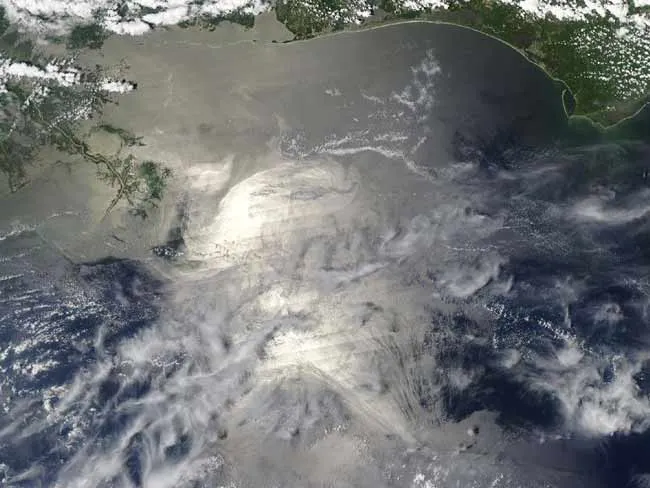
Sunlight Glints Off Surface of Oil Slick
Get the world’s most fascinating discoveries delivered straight to your inbox.
You are now subscribed
Your newsletter sign-up was successful
Want to add more newsletters?
Delivered Daily
Daily Newsletter
Sign up for the latest discoveries, groundbreaking research and fascinating breakthroughs that impact you and the wider world direct to your inbox.
Once a week
Life's Little Mysteries
Feed your curiosity with an exclusive mystery every week, solved with science and delivered direct to your inbox before it's seen anywhere else.
Once a week
How It Works
Sign up to our free science & technology newsletter for your weekly fix of fascinating articles, quick quizzes, amazing images, and more
Delivered daily
Space.com Newsletter
Breaking space news, the latest updates on rocket launches, skywatching events and more!
Once a month
Watch This Space
Sign up to our monthly entertainment newsletter to keep up with all our coverage of the latest sci-fi and space movies, tv shows, games and books.
Once a week
Night Sky This Week
Discover this week's must-see night sky events, moon phases, and stunning astrophotos. Sign up for our skywatching newsletter and explore the universe with us!
Join the club
Get full access to premium articles, exclusive features and a growing list of member rewards.
The sun's rays were seen glinting off the surface of the massive oil slick in the Gulf of Mexico by the eyes of a NASA satellite.
A visible-light image, obtained by the Moderate Resolution Imaging Spectroradiometer instrument aboard NASA's Aqua satellite, showed three bright areas of sunglint within the area of the gray-beige colored spill.
Sunglint is a mirror-like reflection of the sun off the water's surface.
In calm waters, the rounded image of the sun would be seen in a satellite image. However, the waves in the Gulf blurred the reflection and created an appearance of three bright areas in a line on the ocean's surface.
In this image, bright oil slicks appear east and southeast of the Mississippi Delta. Not all of the colored water in the image is tainted by oil though; along the left edge of the image, the camel-toned water is probably freshwater filled with sediment.
Worries have mounted in recent days that the oil could be swept up into a current that would bring it closer to Florida and the fragile coral reefs of the Caribbean. According to the May 18 National Oceanic and Atmospheric Administration (NOAA) web update of the Deepwater Horizon incident, "satellite imagery on May 17 indicated that the main bulk of the oil is dozens of miles away from the Loop Current, but that a tendril of light oil has been transported down close to the Loop Current."
- Top 10 Worst Oil Spills
- Images: SOS! Major Oil Disasters at Sea
- What Is the Loop Current?
Get the world’s most fascinating discoveries delivered straight to your inbox.