













Huge Layers of Rocks on Early Earth Vanished. And Stealthy Scientists May Have Finally Found Them.

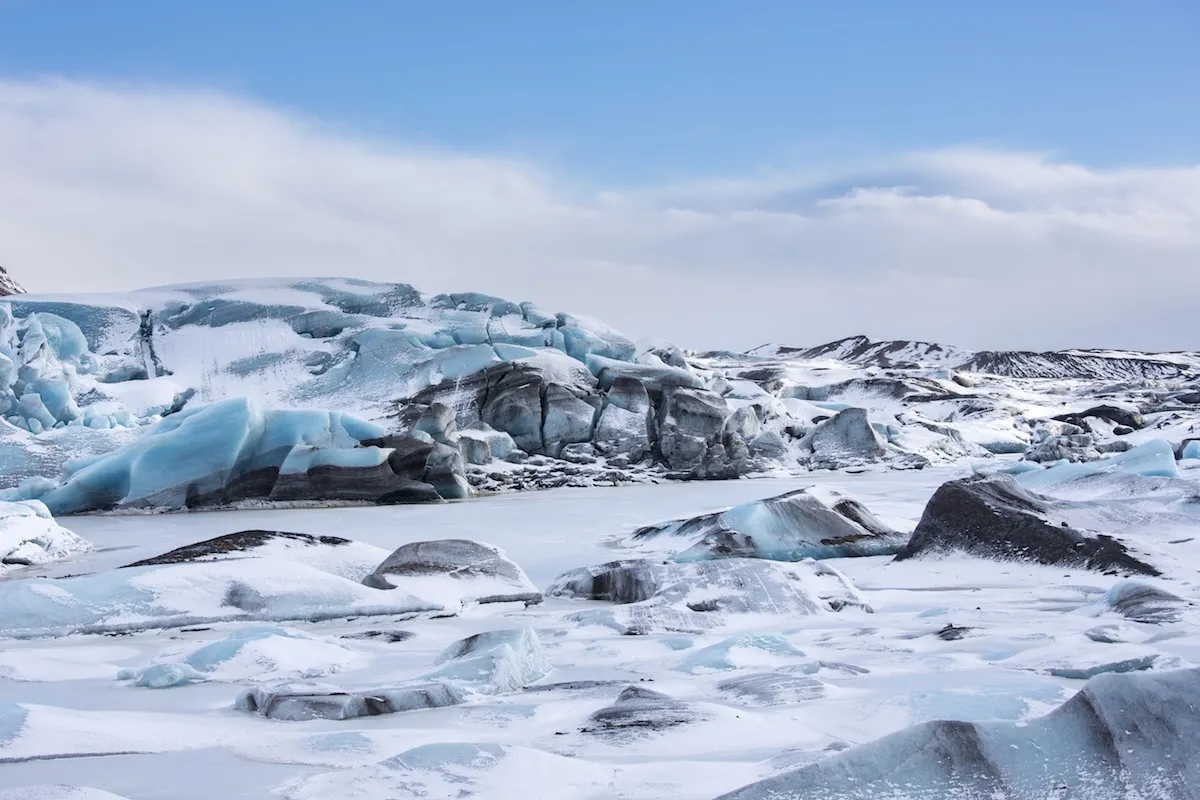
The Earth is missing some of its crust, and now scientists have a new lead on what's to blame: A lot of glaciers.
Nearly 720 million years ago, Earth was cloaked in global ice, an era known as Snowball Earth. The grinding of these worldwide ice sheets may have bulldozed between 1.8 and 3 miles (3 and 5 kilometers) of crust into the oceans, researchers reported Dec. 31. There, plate tectonics crunched it back into Earth's hot middle layer, the mantle, recycling it into new rock. [In Photos: Ocean Hidden Beneath Earth's Surface]
If the scientists are right, Snowball Earth explains a very weird feature of geology called the Great Unconformity. Seen around the world, this unconformity refers to a layer where sedimentary rocks have been deposited right on top of the oldest basement rock of the crust. Bizarrely, hundreds of millions of years of sedimentary layers are missing between this igneous or metamorphic basement and the oldest preserved sedimentary rocks. In the Grand Canyon, for example, a mind-boggling 1.2 billion years of rock are simply missing.
Mineral mystery
C. Brenhin Keller, a geochronologist at the University of California, Berkeley, wasn't attempting to explain the Great Unconformity when he launched his research on zircons, minerals that are so tough and hardy that they survive longer than any other parts of the crust on Earth. The oldest zircons are 4.4 billion years old, only 165 million years younger than the planet itself.
Because zircons can survive just about anything, they hold records of Earth's crust even as they are melted, remixed and recycled in the mantle to form new rock. Keller and his team gathered data on some 34,000 zircons, focusing on the values of particular isotopes, or molecular variants, called hafnium-176 and hafnium-177.
Hafnium-176 is an isotope of the silvery metallic element hafnium that forms during radioactive decay of lutetium, another silvery element. Lutetium tends to stay within the mantle, rather than becoming incorporated in magma and shooting into the crust via volcanic eruptions, Keller told Live Science. As a result, the mantle is particularly rich in lutetium, and thus it's also rich in the hafnium-176 that forms as lutetium decays. The crust, in comparison, is richer in another isotope of hafnium, hafnium-177. For that reason, the ratio of hafnium-176 to hafnium-177 in a zircon can tell researchers whether that zircon formed from magma that originated in the mantle — or from magma that was recycled from the melting of old crust.
Recycled crust
Much to Keller and his colleagues' surprise, the ratios in the zircon revealed that a major amount of old crust had been recycled and remelted to make new zircons, and all at one time. It was "really dramatic," Keller said.
Get the world’s most fascinating discoveries delivered straight to your inbox.
"If you want to do this at global scale you need to get a lot of crust hot and melt it into new magma," he said.
To do that quickly, a lot of crust would have to melt rapidly in the lower crust, Keller said, or it would have to be pushed down into the mantle at the seabed in a process called subduction. Luckily, traveling through water leaves a specific set of molecular fingerprints on the oxygen molecules within zircons, so Keller and his team could check to see whether the zircons (and the rocks that once hosted them) had taken a watery voyage. It turns out they had. [Photos: The World's Weirdest Geological Formations]
A story was emerging: Massive amounts of crust, rather suddenly transferred to ocean subduction zones to be crunched back down into the mantle. But if all that crust moved into the ocean, someone probably should have noticed the erosion, Keller said.
"And indeed we have — in the Great Unconformity," he said.
Wiped clean
Keller admits that this is an extraordinary claim and will require extraordinary evidence. He and his colleagues took a step toward providing some of that evidence by looking at another line of research, on impact craters. Around 700 million years ago, they found, the Earth's impact craters were wiped nearly clean. Only two huge craters, the Sudbury basin in Canada and the Vredefort crater in South Africa, predate Snowball Earth — and those craters were staggeringly enormous, originally measuring 93 miles (150 km) and 185 miles (300 km) across, respectively. They've been eroded to a fraction of their original size. [Crash! 10 Biggest Impact Craters on Earth]
Keller and his team think that the glaciers of Snowball Earth wiped clean all other impact craters, scraping a bit off the top of Sudbury and Vredefort, too. By their calculations, an average of between 1.8 and 3 vertical miles (3 and 5 km) of crust were scraped away by Snowball Earth's ice sheets over 64 million years. In some spots, Keller said, the loss was greater, and in others, no crust was lost at all.
The ice would have had to shave only an average of 0.002 inches (0.0625 millimeters) of dirt and rock off the crust each year to accomplish this feat, Keller said. That's a breeze even for modern-day glaciers, he said. Today, erosion rates for continental ice sheets range from 0.004 to 0.19 inches (0.1 to 4.8 mm), with steep mountain glaciers moving nearly 4 inches (100 mm) of rock and dirt annually.
Scientists had considered glaciers as a possible cause of the Great Unconformity before, but the idea had been largely abandoned, Keller said. A 1973 paper on the idea by University of North Carolina geologist William White failed to garner a single citation by other researchers. Other theories include the impossible (giant tides that wiped the land clean, but would have required the moon to form billions of years later than it actually did) and the more reasonable (the uplift and subsequent weathering of a massive supercontinent).
It's possible that both uplift and glaciers played a role in clearing out kilometers of crust, Keller said. In 2013, researchers found that rocks of the Snowball Earth era had captured and stored carbon dioxide from the atmosphere, perhaps because extreme weathering had made the rocks particularly porous. This capture of carbon dioxide could have triggered global cooling, the flip side of the global warming occurring in modern times due to the burning of fossil fuels. The cooling could have led to a global icy climate, and the resulting glaciers could have then sped up erosion even more.
Keller and his team are working to get funding to test the deep basement rocks under the Great Unconformity to find out when they were lifted to the surface. Unraveling the timing of the uplift and the glaciation, he said, could help clarify what triggered Snowball Earth — and what is ultimately responsible for Earth's vanishing crust.
- 25 Strangest Sights on Google Earth
- Earth from Above: 101 Stunning Images from Orbit
- The Strangest Places on Earth (Photos)
Editor's Note: This article was update to indicate the moon would've needed to form "later" not "earlier" as had been stated, in order to support a giant tide theory to explain the missing layers.
Originally published on Live Science.

Stephanie Pappas is a contributing writer for Live Science, covering topics ranging from geoscience to archaeology to the human brain and behavior. She was previously a senior writer for Live Science but is now a freelancer based in Denver, Colorado, and regularly contributes to Scientific American and The Monitor, the monthly magazine of the American Psychological Association. Stephanie received a bachelor's degree in psychology from the University of South Carolina and a graduate certificate in science communication from the University of California, Santa Cruz.