













Earth's Mysterious 'Deep Biosphere' Is Home to Millions of Undiscovered Species, Scientists Say

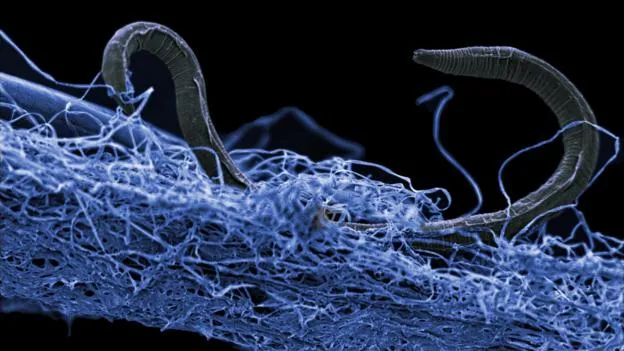
Life on Earth takes billions of shapes, but to see most of them you'll have to dig deep below the planet's surface.
For the past 10 years, that's what the scientists of the Deep Carbon Observatory (DCO) have been doing. Composed of more than 1,000 scientists from 52 countries around the world, this group of scientists maps the weird, wild life of Earth's "deep biosphere" — the mysterious patchwork of underground ecosystems that exists between Earth's surface and its core. It might sound like an unglamorous world of dirt, darkness and daunting pressure but, according to new research from the DCO, harsh conditions haven't stopped millions of undiscovered species of microbial life from evolving there since the planet's birth. [Extreme Life on Earth: 8 Bizarre Creatures]
In a statement that dubs Earth's deep biosphere a "subterranean Galapagos" waiting to be studied, DCO scientists estimate that the sheer biomass of carbon-based life lurking below our feet utterly dwarfs the amount of life roaming the Earth's surface. With about 17 billion to 25 billion tons of carbon (15 to 23 billion metric tonnes) under the planet's surface, DCO researchers estimate there is nearly 300 to 400 times as much carbon biomass underground (most of it still undiscovered) as there is in all the humans on Earth.
"Even in dark and energetically challenging conditions, intraterrestrial ecosystems have uniquely evolved and persisted over millions of years," Fumio Inagaki, a geomicrobiologist at the Japan Agency for Marine-Earth Science and Technology and DCO member, said in the statement . "Expanding our knowledge of deep life will inspire new insights into planetary habitability, leading us to understand why life emerged on our planet and whether life persists in the Martian subsurface and other celestial bodies."
Indeed, studying Earth's deep microbial life has already pushed the understanding of the conditions under which life can thrive. Researchers have drilled miles into the seafloor and sampled the microbiomes from mines and boreholes at hundreds of sites around the world. Data from these sites suggest that the world's deep biosphere spans roughly 500 million cubic miles (2.3 billion cubic kilometers) — about twice the volume of all the Earth's oceans — and houses about 70 percent of all the planet's bacteria and single-cell archaea.
Some of these species make their homes among the world's hottest, deepest niches. A frontrunner for Earth's hottest organism in nature is the single-celled Geogemma barossii, according to the statement. Living in hydrothermal vents on the seafloor, this microscopic spherical lifeform grows and replicates at 250 degrees Fahrenheit (121 degrees Celsius), well above the boiling point of water at 212 degrees F (100 degrees C).
Meanwhile, the record for deepest-known life so far is about 3 miles (5 km) below the continental subsurface and 6.5 miles (10.5 km) below the ocean's surface. Under this much water, extreme pressure becomes an unavoidable fact of life; at about 1,300 feet (400 meters) depth, the pressure is about 400 times greater than at sea level, the researchers wrote.
Get the world’s most fascinating discoveries delivered straight to your inbox.
Expanding what we know about the limits of life on Earth could potentially give scientists new criteria for searching for life on other planets. If there are potentially millions of undiscovered organisms growing, thriving and evolving in the dark of our planet's crust, then our studies of biodiversity on Earth so far have, literally, only scratched the surface.
- Infographic: Tallest Mountain to Deepest Ocean Trench
- 7 Theories on the Origin of Life
- Religion and Science: 6 Visions of Earth's Core
Originally published on Live Science.

Brandon is the space / physics editor at Live Science. With more than 20 years of editorial experience, his writing has appeared in The Washington Post, Reader's Digest, CBS.com, the Richard Dawkins Foundation website and other outlets. He holds a bachelor's degree in creative writing from the University of Arizona, with minors in journalism and media arts. His interests include black holes, asteroids and comets, and the search for extraterrestrial life.