













Did Vesuvius Victims' Brains Really Boil and Their Skulls Explode?

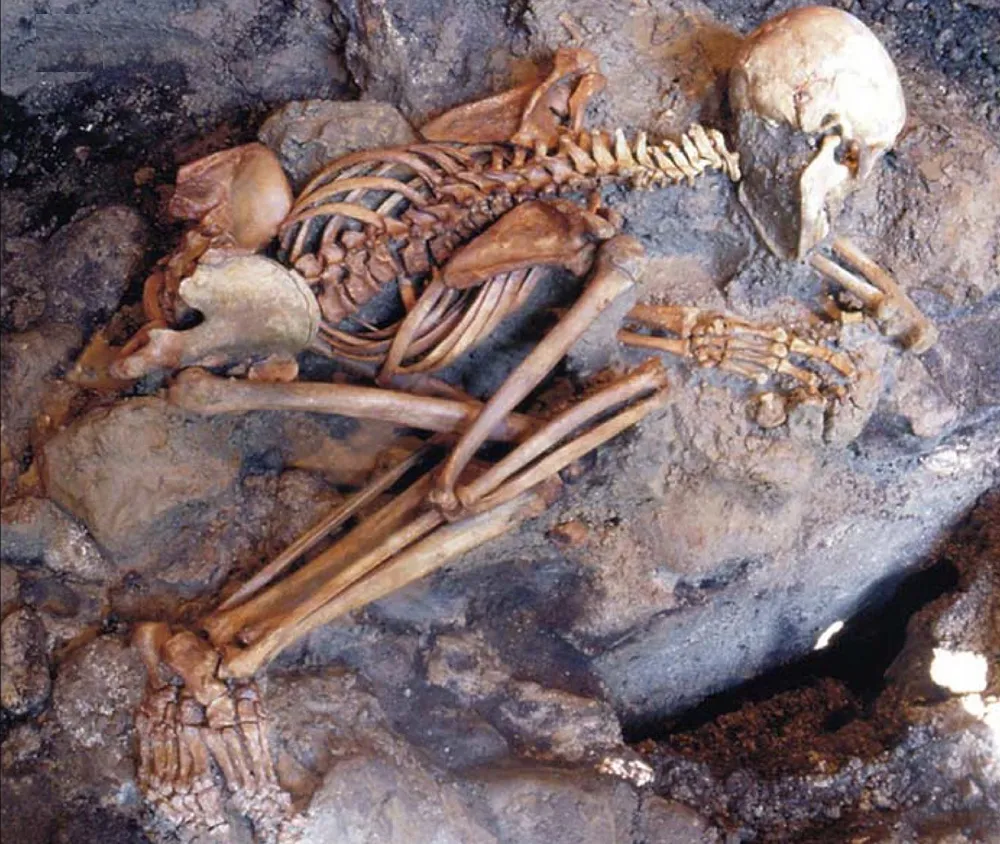
Some victims of the A.D. 79 eruption of Mount Vesuvius may have died when a hot ash cloud boiled their bodily fluids and caused their skulls to explode, a new study argues.
It's an almost unthinkably gruesome method of death. It's also unlikely, according to one expert on heat damage to human remains. Though the victims certainly suffered a fiery demise, exploding skulls and vaporization of tissue is probably a little over the top, said Elżbieta Jaskulska, a biological anthropologist at the University of Warsaw in Poland who was not involved in the new research.
"The idea was, there was so much heat that the body had evaporated on the spot," Jaskulska told Live Science "There is not such a possibility." [See Photos of the Preserved Skeletons from the Mount Vesuvius Eruption]
Death by Vesuvius
The Vesuvius victims in question were former residents of Herculaneum, a town even closer to the maw of the volcano than the famous site of Pompeii. When Vesuvius blew its top, it lobbed pumice, spit ash and ultimately spewed a cloud of hot ash and deadly gases called pyroclastic flow. Many in Pompeii were killed by falling debris, said biological anthropologist Kristina Killgrove of the University of North Carolina, Chapel Hill, who wrote about the study for Forbes Magazine. Others died in the surges of pyroclastic flow.
In the new research, Pierpaolo Petrone of the Federico II University Hospital in Naples, Italy, and colleagues examined the skeletons of people who had taken shelter from the eruption in 12 waterfront chambers in Herculaneum. Among the 140 or so people who died, there were men, women, children and at least one pregnant woman, whose 7-month-old fetus' bones were found among the bones of her pelvis. It was thought that the people in the shelters likely died of asphyxiation as toxic gases and fine ash from the pyroclastic flow filled the room. [25 Grisly Archaeological Discoveries]
Petrone and his colleagues used mass spectrometry, a method of determining the type of matter in a sample based on the masses of its molecules, to study 103 bone samples from the waterfront chambers and a nearby beach. They were particularly intrigued by a reddish residue that coated some of the bones and skulls.
Their results revealed that the residue was high in iron and iron oxides. These residues, especially on the skulls, suggest "massive heat-induced hemorrhage," the authors wrote in their study, published online Sept. 26 in the journal PLOS ONE. What's more, they added, star-shaped fractures on some of the skulls likely indicate that the vaporization of blood and brain matter caused the skulls to explode like unpierced baked potatoes in the microwave.
Get the world’s most fascinating discoveries delivered straight to your inbox.
The researchers bolstered their argument of sudden, heat-driven death rather than asphyxiation with other features of the skeletons. Most victims of fire, for example, assume a "pugilistic pose" in death, with arms and legs drawn up as if ready to punch or kick. This happens because the muscles contract as they dry. But the Herculaneum victims rarely show the full pugilistic pose, Petrone and his colleagues wrote, suggesting that their muscles burned away so quickly that they never had time to contract as in a typical fire death.
"The rapidity of this process is testified by the heat effects found on the bones, which means that after tissue vaporization the ash was still hot enough to carbonize bone," Petrone wrote in an email to Live Science. The cause of death, he said, would have been thermal shock, or intense heat, particularly the boiling of brains and blood in the skull.
The evidence "seem[s] to suggest the rapid vaporization of body fluids and soft tissues of victims resulting from exposure to the extreme high temperature of the ash-avalanches," he and his colleagues concluded in the new paper.
Death by fire
Pyroclastic flows can undeniably cause death by thermal shock — and in a lot of other ways. A 1990 study on the medical effects of volcanic eruptions published in the Bulletin of Volcanology found that within the direct path of a pyroclastic flow, bodies were burned, buried in ash and pummeled by boulders and rock; one person in the direct path of the pyroclastic flow at Mount St. Helens had been dismembered. In addition, one person who took shelter in his car was asphyxiated. On the parameters of the direct flow zone at Mount St. Helens, asphyxia was a more common cause of death than thermal burns, according to the study. [Photos: The Incredible Eruption of Mount St. Helens]
In St. Pierre, Martinique, in 1902, the eruption of Mount Pelée killed 28,000 people. Bodies were found in many different positions, with some in the pugilistic pose that suggested exposure to intense heat, and others sprawled or contorted, the 1990 paper reported. Only two people in the entire city survived: A cobbler who took shelter indoors and somehow lived while the others around him died, probably of asphyxiation, and a prisoner who was incarcerated inside a thick-walled jail cell with only a small grate. Both were badly burned. There were also several survivors on ships in the city's harbor, which were touched only by the edge of the pyroclastic cloud. Those who lived were the ones who managed not to damage their respiratory systems by breathing in hot, glass-sharp shards of volcanic ash, but many still had thermal burns on their skin.
In June, the eruption of Guatemala's Volcán de Fuego killed more than 100 people, mostly victims of pyroclastic flows; these flows were caught on camera. The bodies found in the ash flows generally still had soft tissue, according to an Associated Press report, but it was often charred beyond recognition.
The Herculaneum victims, then, could very well have died almost instantly from thermal burns to their skin and respiratory tracts. They also might have survived the heat influx and asphyxiated. But it's hard to tell which is true from the new analysis, Jaskulska said.
The bones, she said, showed damage consistent with the first phase of burning. They're blackened and charred, indicating that the flesh did burn away in some places. But that's not necessarily evidence that death was instantaneous from heat shock, Jaskulska said. The victims could have died by asphyxiation and been burned immediately following death or experienced both (likely equally fatal) effects at the same time.
The imagination-grabbing notion that the blast melted flesh from bone and exploded the victims' skulls is more far-fetched, Jaskulska said.
The researchers estimate that the pyroclastic flow would have reached temperatures between 392 and 932 degrees Fahrenheit (200 and 500 degrees Celsius). That's simply not hot enough to flash-fry a human body. Modern crematoriums run at between 1,472 and 1,832 degrees F (800 and 1,000 degrees C), and they still take some time to burn flesh from bone, Jaskulska said.
"We have tables describing when each of the changes in the cadaver due to heat exposure happen," she said.
At 1,292 degrees F (700 degrees C), it takes 10 minutes to burn away the flesh on the skull and badly char the face, Jaskulska said. It takes 25 minutes to burn away the flesh of the legs. Rather than burning the muscles to ash before they had time to contract, the pyroclastic flow (which may have been moving at around 186 mph, or 300 km/h) is more likely to have moved past too quickly to fully burn the muscles into the "pugilistic pose."
Nor is it likely that the victims' boiling brains exploded their skulls, Jaskulska said. There is some scientific literature that suggests that heated skulls can explode, but the evidence is shaky, she said. Footage from inside crematoriums shows skulls heated to 1,832 degrees F (1,000 degrees C) without exploding. Skulls, after all, are not closed systems. They're open at their base, at the mouth, the nasal passages, and the eye orbits. Any vaporized fluid from the braincase has plenty of places to escape, Jaskulska said.
However, bones become brittle when burnt and can easily crack due to thermal expansion, Jaskulska said. The damage seen in the Herculaneum skeletons is consistent with this sort of heat-expansion cracking. [The Facts and Theories of Spontaneous Human Combustion]
Finally, Jaskulska said, the iron-rich residues on the bones could very well have come from evaporated blood and bodily fluids. But it's hard to tell whether that happened at the moment of the pyroclastic cloud's impact, or in the subsequent hours of eruption, when hot ash continued to fall over the victims' bodies.
"We know that it was not a process that when started was very quickly finished, that ash raining on the area and pyroclastic clouds were probably repeatedly coming down for a few hours at least," Jaskulska said.
One point of contention is whether research on cremated remains mimics the damage from pyroclastic flows. Pyroclastic clouds are oxygen-free environments, Perone said, so the heat occurs in the absence of flame.
Instant heat shock would likely have been a more merciful cause of death than asphyxiation by gases and ash. Survivors who have encountered even the mildest pyroclastic flow have described intense heat, blistering and peeling skin and a sense of suffocation or choking on ash, according to the 1990 research. Some who took shelter indoors watched fellow victims linger for over an hour before succumbing to the damage to their lungs.
Original article on Live Science.

Stephanie Pappas is a contributing writer for Live Science, covering topics ranging from geoscience to archaeology to the human brain and behavior. She was previously a senior writer for Live Science but is now a freelancer based in Denver, Colorado, and regularly contributes to Scientific American and The Monitor, the monthly magazine of the American Psychological Association. Stephanie received a bachelor's degree in psychology from the University of South Carolina and a graduate certificate in science communication from the University of California, Santa Cruz.