Earth is being bombarded with invisible light that nobody understands.
Known as fast radio bursts (or FRBs), these ultrashort, ultrapowerful pulses of ancient energy are the universe's brightest flashes you cannot see. They travel billions of light-years across time and space, shine with the intensity of nearly 100 suns and then blip out of existence mere milliseconds after reaching the range of Earthly telescopes. Because they are radio waves, they do all of this while remaining totally invisible to human eyes.
Today (Oct. 10), a new study published in the journal Nature adds evidence to that assertion, thanks to a high-tech telescope in Australia.
"We’ve found 20 fast radio bursts in a year, almost doubling the number detected worldwide since they were discovered in 2007," lead study author Ryan Shannon, an astronomer at Swinburne University of Technology and the International Centre for Radio Astronomy Research (ICRAR) in Australia, said in a statement. "We’ve also proved that fast radio bursts are coming from the other side of the universe rather than from our own galactic neighborhood."
An intergalactic catcher's mitt
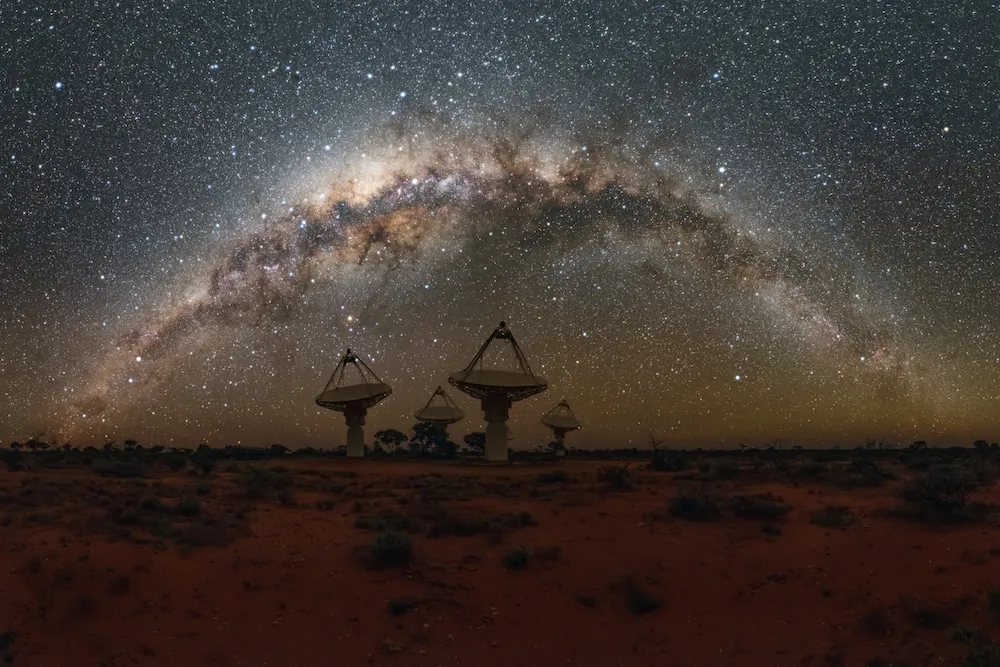
In their new study, Shannon and his colleagues used the Australian Square Kilometre Array Pathfinder (ASKAP) — a cluster of 36 identical antennas linked up to a single, powerful radio telescope — to monitor a wider swath of sky for FRBs than has ever been observed before.
Each ASKAP antenna watches the sky at a slightly different angle, leaning out of the remote, scrubby plains of western Australia to stare down 240 square degrees of space all at once. According to the researchers, the array monitors a slice of sky with "about a thousand times the area of the full Moon," providing one of the world's greatest catcher's mitts for intergalactic radio transmissions.
Sign up for the Live Science daily newsletter now
Get the world’s most fascinating discoveries delivered straight to your inbox.
So, what do you do after you catch an FRB by the toe? For starters, ask it where it came from.
An artist’s impression of CSIRO’s ASKAP radio telescope detecting a fast radio burst (FRB).
(Image credit: OzGrav, Swinburne University of Technology)
Mapping missing matter
After recording 20 new FRBs in the past year, ASKAP scientists have also been able to estimate how far each pulse of light has traveled across the cosmos. As FRBs surge through the universe, they pass through clouds of intergalactic dust and gas that slow and stretch the light's waveform.
"The burst [then] reaches Earth with its spread of wavelengths arriving at the telescope at slightly different times, like swimmers at a finish line," study co-author Jean-Pierre Macquart, a senior lecturer at ICRAR, said in the statement. "Timing the arrival of the different wavelengths tells us how much material the burst has travelled through on its journey."
The wider the spread of wavelengths in a given pulse, the more likely that pulse has traveled through an enormous stretch of the universe — perhaps several billions of light-years — before finally colliding with Earth. In fact, Macquart said, studying FRBs could even help astronomers figure out exactly what types of matter exist between galaxies.
About one third of the universe's run-of-the-mill matter made of protons and neutrons (also called "baryonic matter") is thought to exist somewhere in clouds of gas between distant stars, according to a study published earlier this year. Studying how FRBs warp and slow in certain parts of the sky could help pinpoint where, exactly, those clouds of baryons really are.
"[FRBs] can act as cosmic lighthouses,"Macquart said in a video accompanying the new study. "They can actually find that matter, find where it’s lurking in the universe and find out exactly how much is missing."
Further study of these invisible blasts of space-light could go a long way toward completing our map of the known universe. So, let's hope that if FRBs are indeed caused by superintelligent alien spaceships, they're thrusting away from Earth.
Brandon is the space / physics editor at Live Science. With more than 20 years of editorial experience, his writing has appeared in The Washington Post, Reader's Digest, CBS.com, the Richard Dawkins Foundation website and other outlets. He holds a bachelor's degree in creative writing from the University of Arizona, with minors in journalism and media arts. His interests include black holes, asteroids and comets, and the search for extraterrestrial life.