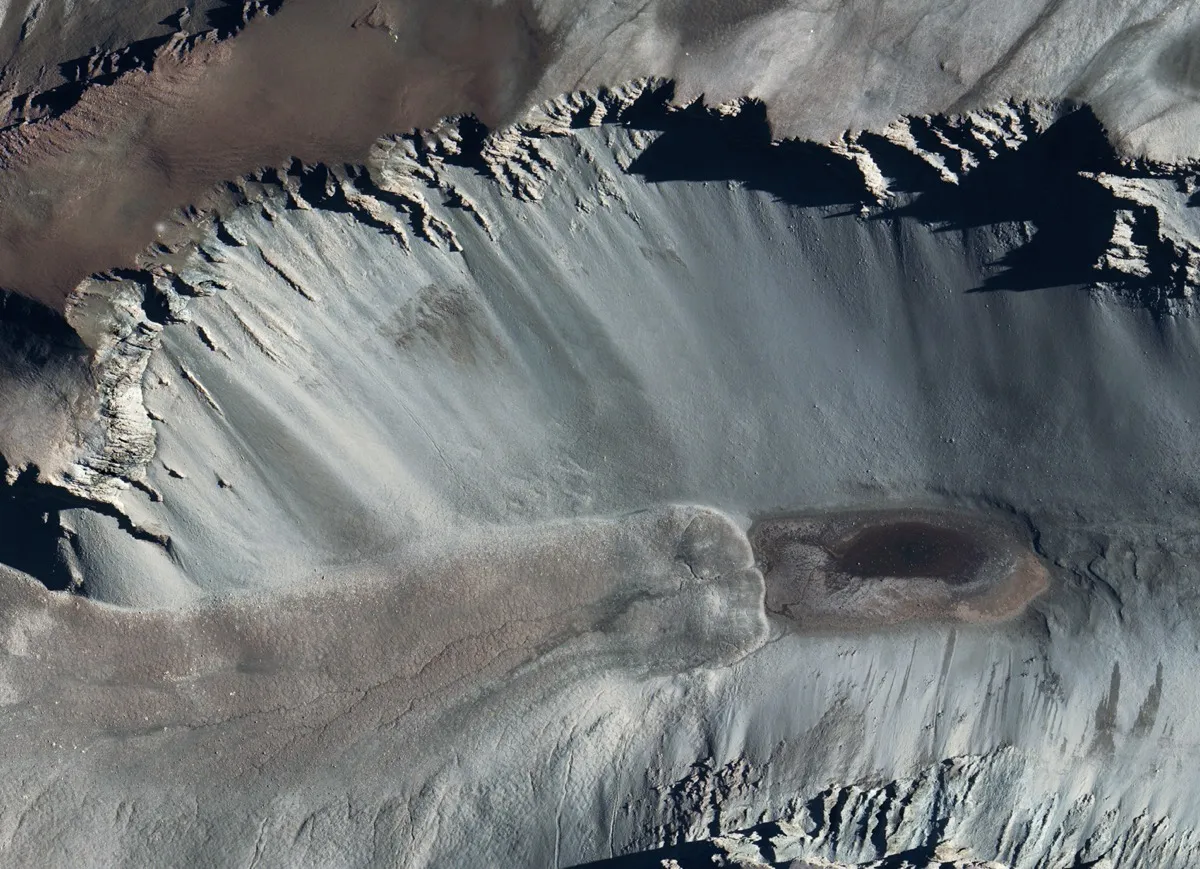
Understanding the hydrology of one of the planet's saltiest bodies of water, Don Juan Pond in Antarctica, could help scientists figure out mysteries about environments on Mars.
At the bottom of the world, in a frigid Antarctic desert, sits a weird pond only a few inches deep that is so salty, it stays liquid even at temperatures of minus 58 degrees Fahrenheit (minus 50 degrees Celsius).
The source of the pond's unusually heavy and pure load of salt has been a geochemical mystery since it was discovered during a 1961 expedition. Scientists had generally assumed that Don Juan Pond — a play on the names of the expedition's helicopter pilots — was fed by deep groundwater, but a widely publicized 2013 paper suggested the salts came from a shallower source.
In the new study, published Sept. 15 in the journal Earth and Planetary Science Letters, researchers used computer models of the pond's chemistry to dispute that finding.
Because the area is one of the closest terrestrial analogues to Mars, understanding how water flows through the pond and the surrounding area could help scientists understand the behavior of similar features on the Red Planet. [The 7 Most Mars-Like Places on Earth]
The salt in Don Juan Pond isn't the same as the stuff that gets sprinkled on food. Instead, it is 95 percent calcium chloride, which significantly lowers the freezing point of water, helping the pond stay liquid even into the bitter Antarctic winter.
The liquid in Don Juan Pond, located in Antarctica's Wright Valley, is almost 45 percent salts by weight.
(Image credit: Pierre Roudier/Flickr)
It's rare for nature to produce a water solution so pure, said study co-author Jonathan Toner, a geochemist at the University of Washington. From a chemistry perspective, "it's kind of like walking into the room and seeing a pink elephant," he told Live Science.
All that salt makes the water denser and more viscous than the water that pours from taps or laps up on beaches, giving it the consistency of a thin syrup, Toner said.
Sign up for the Live Science daily newsletter now
Get the world’s most fascinating discoveries delivered straight to your inbox.
The pond is so salty (about 40 percent by weight) because of a combination of two factors: the high evaporation rate in the extremely dry environment of the McMurdo Dry Valleys, where it is located, and the ability of calcium chloride to form much more concentrated solutions than plain table salt (sodium chloride).
But where that salt comes from and why the pond is so chemically pure have been long-standing mysteries. And they're difficult to answer because the pond was designated a protected area to prevent any contamination — so there are restrictions on sampling and studying the area.
The 2013 study used time-lapse photography to monitor the flow of water around the pond. The authors concluded that calcium chloride in the surrounding soil was sucking up water from the atmosphere whenever the humidity peaked — a process called deliquescence. That water was visible as streaks of darkened earth on the slopes near the pond. The authors think that periodic snowmelt then washed the salts into the pond. [Photographic Proof of Climate Change: Time-Lapse Images of Retreating Glaciers]
"But we totally disagreed" with the study authors' conclusions, Toner said. "I think they really didn't consider the past evidence for a deep groundwater source."
He and his colleagues compared the two possible sources of the salt — deep groundwater and the process described in the 2013 paper — with a chemistry model that compared the makeup of the pond water with what would be expected to evolve through evaporation from those two different sources.
They found that the deep groundwater source "matches it exactly, to uncanny accuracy,” while the shallower source "is just nowhere near" it, Toner said.
The study still leaves open the question of where the deep groundwater ultimately comes from. Toner and his colleagues think salty water percolates down through the frozen soils and interacts with surrounding minerals in a way that produces purified plumes of calcium chloride (which they have detected by drilling into the soil), Toner said. But this process happens much more slowly than the 2013 study proposed, from thousands to tens of thousands of years.
Jay Dickson, one of the authors of the 2013 paper and a planetary scientist at Caltech, doesn't think the new study refutes his own because it doesn't address the question of the ultimate source of the salt. He thinks the processes described in each paper may be connected, though Toner disagrees.
The new study also shows that the pond is being continuously flushed out, Toner said, suggesting it is connected to an extensive groundwater system that is also feeding another lake in the valley that is rich in calcium chloride, though not as pure. He also thinks the surface streaks of water could be another manifestation of the groundwater system. [See Photos of Antarctica's Subglacial Lake Whillans]
Understanding that system, as well as the surface streaks of water sucked up by the salty soils, could help reveal more about similar features on the surface of Mars. It is virtually impossible, though, for Mars to have an extensive groundwater system because it simply gets too cold, Dickson said.
"If they're right — that it's a deep groundwater source — [then] that is not happening on Mars today,” he told Live Science.
Toner will be part of a team that will explore and sample the area around Don Juan Pond in December to find more evidence for the source of the salts and the potential connections to a larger groundwater system.
Andrea Thompson is an associate editor at Scientific American, where she covers sustainability, energy and the environment. Prior to that, she was a senior writer covering climate science at Climate Central and a reporter and editor at Live Science, where she primarily covered Earth science and the environment. She holds a graduate degree in science health and environmental reporting from New York University, as well as a bachelor of science and and masters of science in atmospheric chemistry from the Georgia Institute of Technology.