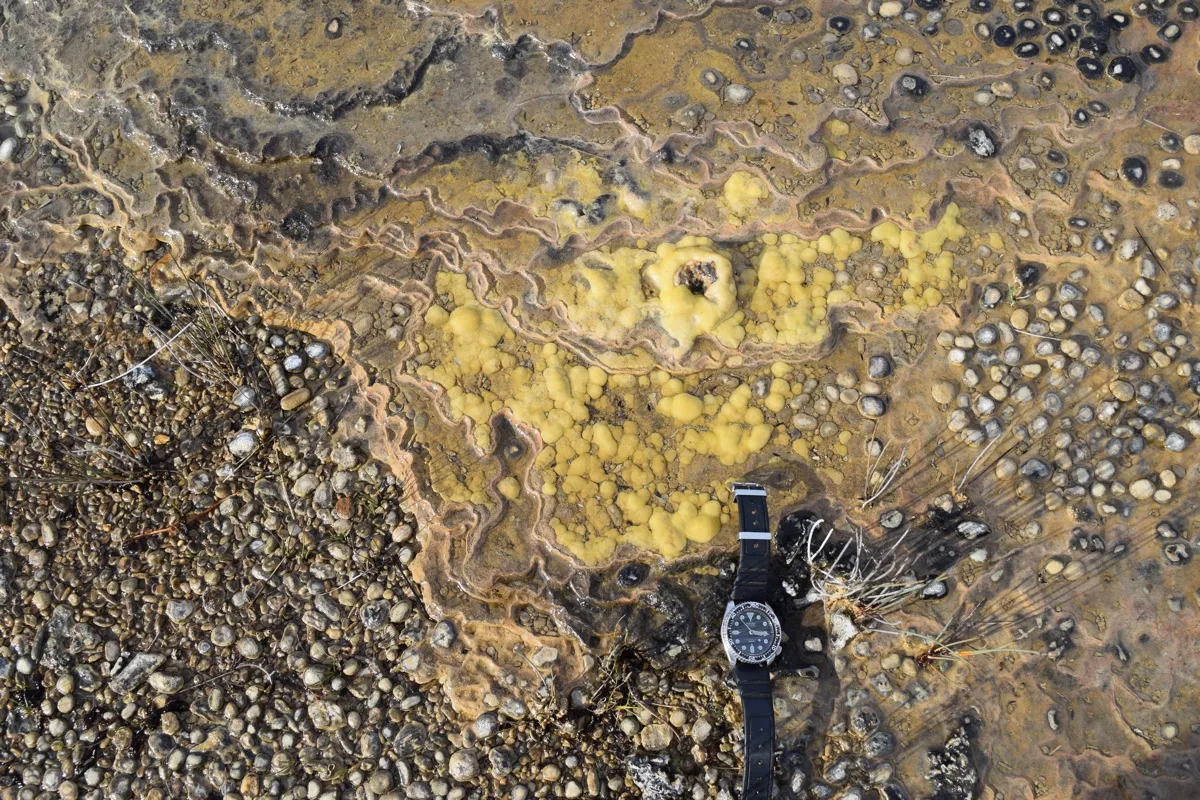
These distinctive wavy globs are a modern-day version of Earth's oldest known life. Stromatolites, microbial mats that thrive on sunlight, have been discovered in Tasmania for the first time. Stromatolites first evolved around 3.5 billion years ago, and they're rare today. Most live in highly salty marine environments, which makes the Tasmania specimens even more special. They live in freshwater.
Earth's first known life was relatively simple: microbial mats that grew in wavy layers, leaving thin pancakes of excreted minerals stacked between them. Stromatolites, as these microbial colonies are known, first appeared on the planet at least 3.5 billion years ago. They're all over the fossil record, but today, they live almost nowhere except for a few shallow, extra-salty marine spots like Hamelin Pool in Shark Bay, Western Australia.
That's why scientists were surprised to stumble across these life-forms in a freshwater wetland in Tasmania in 2015.
The researchers had discovered these living stromatolites — greenish-yellow rounded structures only 4 inches (10 centimeters) across at their largest — thriving on damp, porous rock in the Giblin River valley in southwestern Tasmania. It's an isolated place, said study researcher Bernadette Proemse, a freshwater ecologist at the University of Tasmania, who, along with her colleagues, described this unexpected discovery on Nov. 13 in the open-access journal Scientific Reports.
"The valley we found these stromatolites in is pretty much as remote as you can get in Tasmania," Proemse told Live Science. "It's over about 100 kilometers [62 miles] from the nearest street." [The 10 Strangest Places Where Life Is Found on Earth]
Surprise stromatolites
The research team wasn't searching for new forms of Earth's most ancient life. The wetland site, which lies in the Tasmanian Wilderness World Heritage Area, is unusual because it's pockmarked with sand flats that sit on layers of limestone and dolomite. These substances make the water in the flats slightly alkaline, or basic. The sand flats are surrounded by peaty soil, which is quite acidic. Proemse was invited along on an expedition to this strange landscape to investigate the source of the water in the freshwater wetlands, while other researchers worked to document the flora and fauna.
Living stromatolites in a Tasmanian freshwater wetland. The largest of the microbial mats are only about 4 inches (10 centimeters) in diameter. They grow in layers, excreting calcium in pancake-like stacks. Stromatolites' growth pattern and tendency to leave behind mineral layers is one reason they're so well-known throughout 3.5 billion years of Earth history. In many places, they leave tell-tale wavy-layered fossils behind.
(Image credit: Rolan Eberhard (DPIPWE))
"We very quickly discovered these funny-looking, yellow-greenish microbial mats," Proemse said. The researchers soon recognized the distinctive layered arrangement of the mats and realized they were looking at stromatolites. It was a surprise, Proemse said, because modern stromatolites mostly live in very salty water, or occasionally geothermally heated freshwater. Other than being slightly alkaline, with a pH of around 7.5 (7 is neutral), the wetland water was not that unusual, she said.
"Typically, you get stromatolites in these really funky chemical conditions, so the water that we have at our site is relatively benign compared to the water of other sites," Proemse said.
Sign up for the Live Science daily newsletter now
Get the world’s most fascinating discoveries delivered straight to your inbox.
Protected community
The microbes that make up the stromatolites include cyanobacteria, chloroflexi, armatimonadetes, alphaproteobacteria and planctomycetes, the researchers found. Cyanobacteria and chloroflexi are both photosynthesizers, turning sunlight into energy. Armatimonadetes bacteria have previously been found associated with plants and geothermal environments. Alphaproteobacteria have also been found in symbiotic relationships with plants, while planctomycetes are a group of aquatic bacterial species.
Bernadette Proemes of the University of Tasmania stands in a remote wetland in Tasmania. These wetlands form over calcium-rich limestone and dolomite. The groundwater at the site is thus full of calcium, which seems to be deadly to the local fauna (mainly snails) that would otherwise eat stromatolites. Thus, the wetland may be an unusually well-protected place for the microbial mats to grow.
(Image credit: Karen Richards (DPIPWE))
This community was unlike those seen in other stromatolites, study co-author Rolan Eberhard said in a statement. Eberhard is part of the Natural and Cultural Heritage Division of Tasmania's Department of Primary Industries, Parks, Water and Environment.
The community's unique makeup might reflect the stromatolites' freshwater spring environment. But the real secret to the microbial mats' survival might be the high calcium content of the groundwater, which picks up the element as it leeches through the limestone and calcium bedrock, Proemse said.
The researchers observed multiple small piles of dead snails and empty shells around the margins of the springs where the stromatolites thrived. Many of the shells were burdened by calcium deposits. It seems likely, Proemse said, that the snails can't survive in the calcium-rich waters, so they can't crawl over and chow down on the otherwise defenseless stromatolites.
In fact, she said, one hypothesis for why stromatolites are no longer abundant on Earth is that multicellular life evolved and ate them. The Tasmania stromatolites may have found a loophole in their strange, swampy springs. [7 Theories on the Origins of Life]
The researchers have planned another trip to the site in December, when they hope to find out more about how fast the stromatolites grow and how long they've been living in the wetlands, Proemse said.
"It's very interesting from an Earth-history point of view," Proemse said.
Stephanie Pappas is a contributing writer for Live Science, covering topics ranging from geoscience to archaeology to the human brain and behavior. She was previously a senior writer for Live Science but is now a freelancer based in Denver, Colorado, and regularly contributes to Scientific American and The Monitor, the monthly magazine of the American Psychological Association. Stephanie received a bachelor's degree in psychology from the University of South Carolina and a graduate certificate in science communication from the University of California, Santa Cruz.