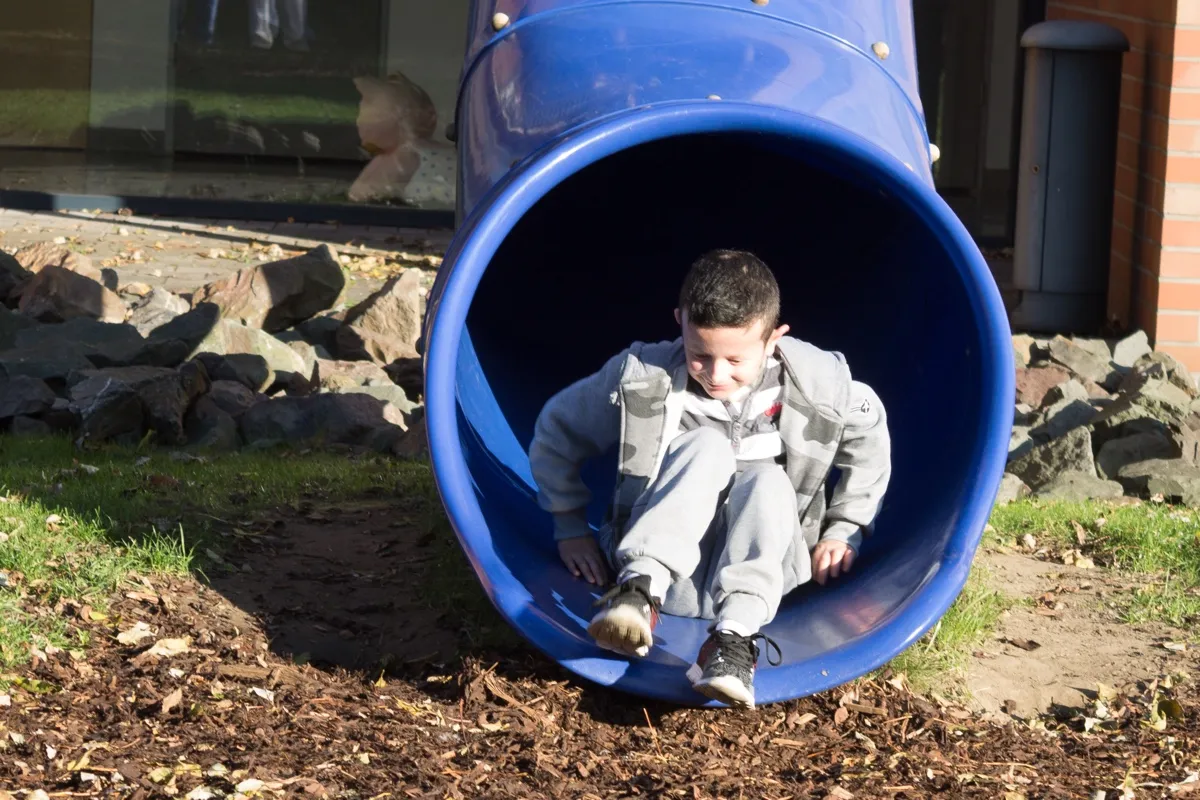
A boy who nearly died from a rare skin disease has recovered thanks to an experimental treatment, his doctors announced this week. The treatment? Giving their young patient new skin using genetically modified stem cells.
The young boy, named Hassan, was 7 years old when he was admitted to the Children's Hospital at Ruhr University in Bochum, Germany, in June 2015. At that time, a genetic disease called epidermolysis bullosa (EB) had destroyed about 60 percent of his skin.
Patients with EB are sometimes called "butterfly children" because their skin is as delicate as a butterfly's wings; it can blister and tear at the slightest disturbance. Complications from the disease can include skin cancer and deadly infections. [Bionic Humans: Top 10 Technologies]
In a video interview, Hassan’s father explained that his son was diagnosed shortly after he was born in Syria, and doctors said there was no cure. About a year after his family arrived in Germany, Hassan’s condition worsened. He would ask his father questions like "Why do I have to live this life? … Why am I not allowed to play soccer?"
Dr. Tobias Rothoeft, a pediatrician at the Children’s Hospital who treated Hassan, described in a statement how deadly the boy's condition was by the time he was admitted in 2015: "He suffered from severe sepsis [a blood infection] with high fever, and his body weight had dropped to a mere 17 kilograms (37 pounds) — a life-threatening condition."
Initially, the doctors tried to treat Hassan's condition with more conservative treatments, such as traditional skin transplants, but these failed to help. So, Hassan's doctors in Germany reached out to Michele De Luca, an expert in stem cell biology at the University of Modena and Reggio Emilia in Italy. They wanted to see if it would be possible to transplant genetically modified stem cells onto Hassan’s body that would correct the mutation that causes EB and generate new, healthy skin.
Scientists used gene therapy to reconstruct a fully functional epidermis for a 7-year-old boy.
(Image credit: Nature News & Views)
Stem cells have the ability to turn into any type of tissue, which makes them valuable in medical research. De Luca's team had previously shown that such a technique could be feasible for EB patients by transplanting a few sheets of skin grown from stem cells in the lab onto a patient’s legs.
Sign up for the Live Science daily newsletter now
Get the world’s most fascinating discoveries delivered straight to your inbox.
Doctors took a small square of healthy skin from a non-blistering part of Hassan's body, and De Luca's lab in Italy used that skin to create the genetically corrected stem cells that they could grow into sheets of skin for grafting. Those sheets, which looked like clear plastic, were successfully transplanted over 80 percent of Hassan’s body during several surgeries at Ruhr University in Bochum in October and November 2015. After a month, most of the transplanted skin had started to regenerate.
Researchers created this sheet of skin from cultured cells that had been genetically modified.
(Image credit: CMR Unimore)
The doctors described the success of their treatment in the journal Nature yesterday (Nov. 8).
"It felt like a dream," Hassan’s father said of his son’s recovery. The boy was finally released from the hospital in February 2016. Today, his skin is still in "great condition," according to his father. Videos from the hospital show that Hassan is even able to play soccer.
The researchers say Hassan is the first patient in the world to get skin transplants from stem cells on a large area of his body. The new skin covered nearly 1 square meter, or 10 square feet.
"This approach has enormous potential for research into and development of new therapies for the treatment of epidermolysis bullosa as well as other diseases and trauma causing large skin defects," lead study author Tobias Hirsch, a plastic surgeon at the Burn Center at Ruhr University, said in a statement.
Megan has been writing for Live Science and Space.com since 2012. Her interests range from archaeology to space exploration, and she has a bachelor's degree in English and art history from New York University. Megan spent two years as a reporter on the national desk at NewsCore. She has watched dinosaur auctions, witnessed rocket launches, licked ancient pottery sherds in Cyprus and flown in zero gravity. Follow her on Twitter and Google+.