













Massive Calved Iceberg Comes into View as Antarctic Sun Rises

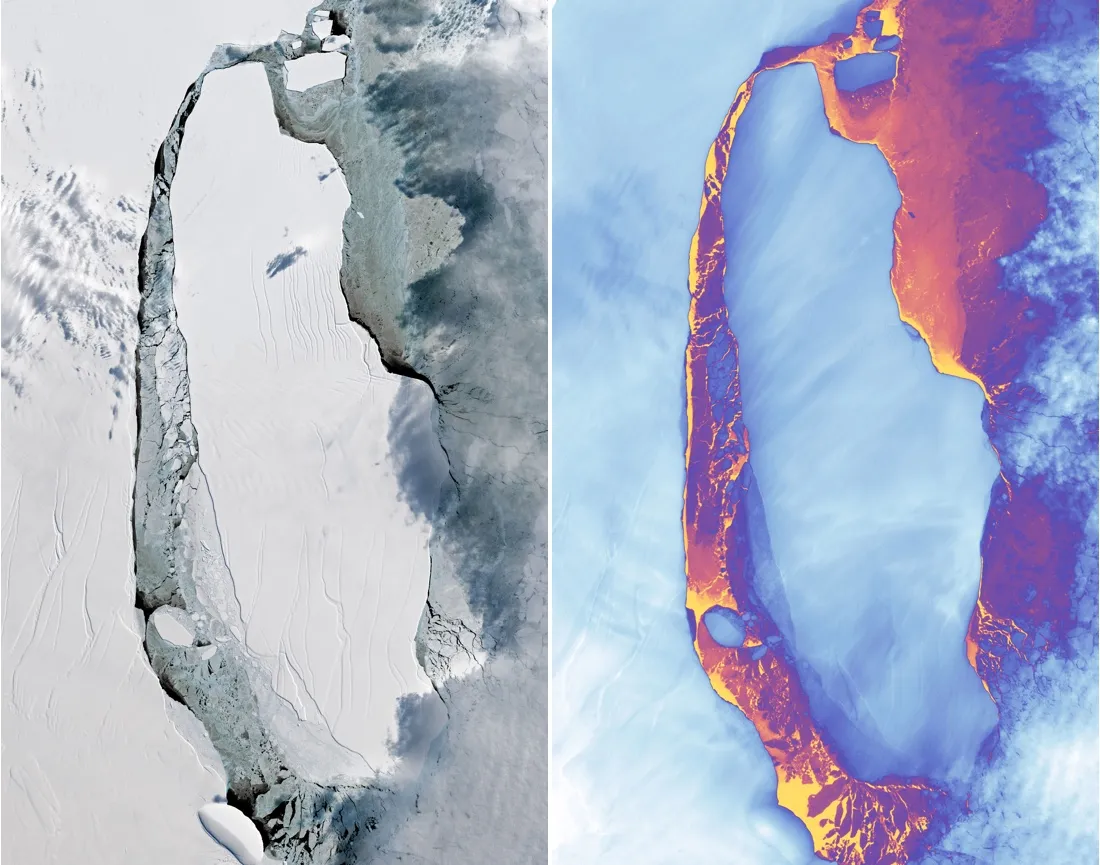
As the sun rises above the Antarctic horizon after the long, dark austral winter, scientists are getting a better look at the Delaware-size iceberg that sheared off from the frozen continent's Larsen C ice shelf in July.
With the illumination from the sun's rays, new satellite images have captured the iceberg, dubbed A68, and the motley assortment of ice and water surrounding it, in impressive detail. In the coming months and years, scientists will be poring over such images to watch the progression of the iceberg and its parent ice shelf.
The researchers said they also hope to study the area up close, to examine details of the seafloor that have been blocked by ice for hundreds of years and to learn how such a massive shift could alter the local ecosystem. [In Photos: Antarctica's Larsen C Ice Shelf Through Time]
"It's obviously a completely different physical environment once the ice is gone," Susie Grant, a marine biogeographer with the British Antarctic Survey, told Live Science.
Keeping tabs on the iceberg, the ice shelf and the ecosystem in the coming years could also help scientists better understand how other major ice shelves might respond to a warming world, according to Grant.
"Extraordinary" images
Scientists have watched for several years as a rift slowly propagated its way across the Larsen C ice shelf, a platform of ice that extends out from the coast and floats atop the ocean. After a couple of surges in 2016 and earlier this year, the rift finally reached the edge of the ice shelf and calved off the iceberg.

But with the sun below the Antarctic horizon, researchers could monitor the event only with thermal imagery and radar, according to NASA's Earth Observatory.
Get the world’s most fascinating discoveries delivered straight to your inbox.
"When it did finally break off, it was just sort of these tantalizing" glimpses, Grant said.
Once the sun re-emerged in August, more satellite views started streaming in — and they haven't disappointed. The "satellite images are extraordinary," Grant said. "To see something of that scale moving across the water."
In mid-September, NASA's Terra satellite and the Landsat 8 satellite captured shots of the iceberg in visible light and of the surrounding area in infrared wavelengths of light. The images reveal exciting details, like the wrinkly-looking rifts that stretch across parts of the iceberg and the mixture of open water and ice surrounding it. [Earth from Above: 101 Stunning Images from Orbit]

In the psychedelic thermal image, the cold iceberg and ice shelf appear a ghostly white, while the relatively warmer sea ice shows up in shades of purple, and the even warmer (though still sub-freezing) open water pops out in yellow. Bluer shades show the mixture of ice called mélange, which can include snow, sea ice, bits of ice that fell from the sides of the rift and something called marine ice, which forms along the underside of the floating ice, said Ala Khazendar, a scientist with NASA's Jet Propulsion Laboratory who uses radar to study polar ice.
Dramatic changes in store?
The images also show how much the iceberg has moved away from its parent ice shelf. So far, it has been progressing at a steady clip, but how fast it might continue to move is unclear and depends on several factors: winds and ocean currents, as well as whether there are any bumps or ridges on the seafloor that the iceberg might get stuck on, Khazendar said.
If it does get stuck, he said, that will tell scientists something about the topography of the seafloor, which they had no way of viewing before the calving event, Grant said.
That seafloor and the water above it are also being exposed to sunlight for the first time in at least hundreds of years, and this could have major impacts on the local ecosystem, Grant said. For instance, ocean life at the water's surface could suddenly ramp up in productivity. The newly opened area could also see species moving in from neighboring regions, she said. [Antarctica Photos: Meltwater Lake Hidden Beneath the Ice]
The ecosystem will be "potentially dramatically changed" by the calving event, Grant said, though it's "impossible to know anything about that until we can get down and visit."
The British Antarctic Survey and other groups are planning scientific cruises to get an up-close look at the changes to the region, and the sooner that happens the better, so they can establish a baseline before major changes occur, Grant said. Sediment cores drilled from the ocean floor will help scientists establish how long the area has been covered by ice, and sampling of the water will tell them how the temperature and salt content may be changing and what creatures live there, she said.
Those efforts are helped by an international agreement by the Commission for the Conservation of Antarctic Marine Living Resources, which has 25 international members, to designate the area around the ice shelf as a protected area so that activities like commercial fishing won't hamper scientific work, Gizmodo reported. This is the first time there has been such a designation, Grant said.
"I think that was a really important step," she said. "We were really pleased to have managed to get that."
Clues to the fate of Antarctic ice
In the meantime, scientists will glean what information they can from satellite images and airborne observations made by NASA's IceBridge program, which is gearing up for the Antarctic summer season, Khazendar said.
Researchers will be watching to see if the remaining ice shelf begins to flow faster in response to the iceberg's loss, he said, and how the iceberg melts and potentially breaks up into smaller pieces (one such piece already broke off later in July).
"We still need to collect data and analyze them in order to understand how the Larsen C ice shelf is going to react to this event," Khazendar said.
There are concerns that the massive calving event could mark a turning point for the glacier, sending it toward a global warming-fueled collapse like those suffered by its northern neighbors, Larsen A and Larsen B, in 1995 and 2002, respectively. But whether that will happen isn't yet clear, and the ice shelf could recover from the calving event, as these events do happen naturally, Khazendar said.
"It will take us some time before we have some clearer answers," he said.
How Larsen C responds could also give scientists a better idea of how other major ice shelves around Antarctica will respond to the warming waters that are lapping away at the shelves' undersides and causing the glaciers that feed into shelves to flow faster out to the ocean, raising sea levels.
"It could teach us a lot about the fate of other large ice shelves in Antarctica," Khazendar said
Studying the region could also "improve our understanding of how ecosystems might respond to the impacts of climate change," Grant said.
Original article on Live Science.

Andrea Thompson is an associate editor at Scientific American, where she covers sustainability, energy and the environment. Prior to that, she was a senior writer covering climate science at Climate Central and a reporter and editor at Live Science, where she primarily covered Earth science and the environment. She holds a graduate degree in science health and environmental reporting from New York University, as well as a bachelor of science and and masters of science in atmospheric chemistry from the Georgia Institute of Technology.