













Selfie-Ready: 'Fish Gape' Helps Adorable Baby Cichlids Mold Faces

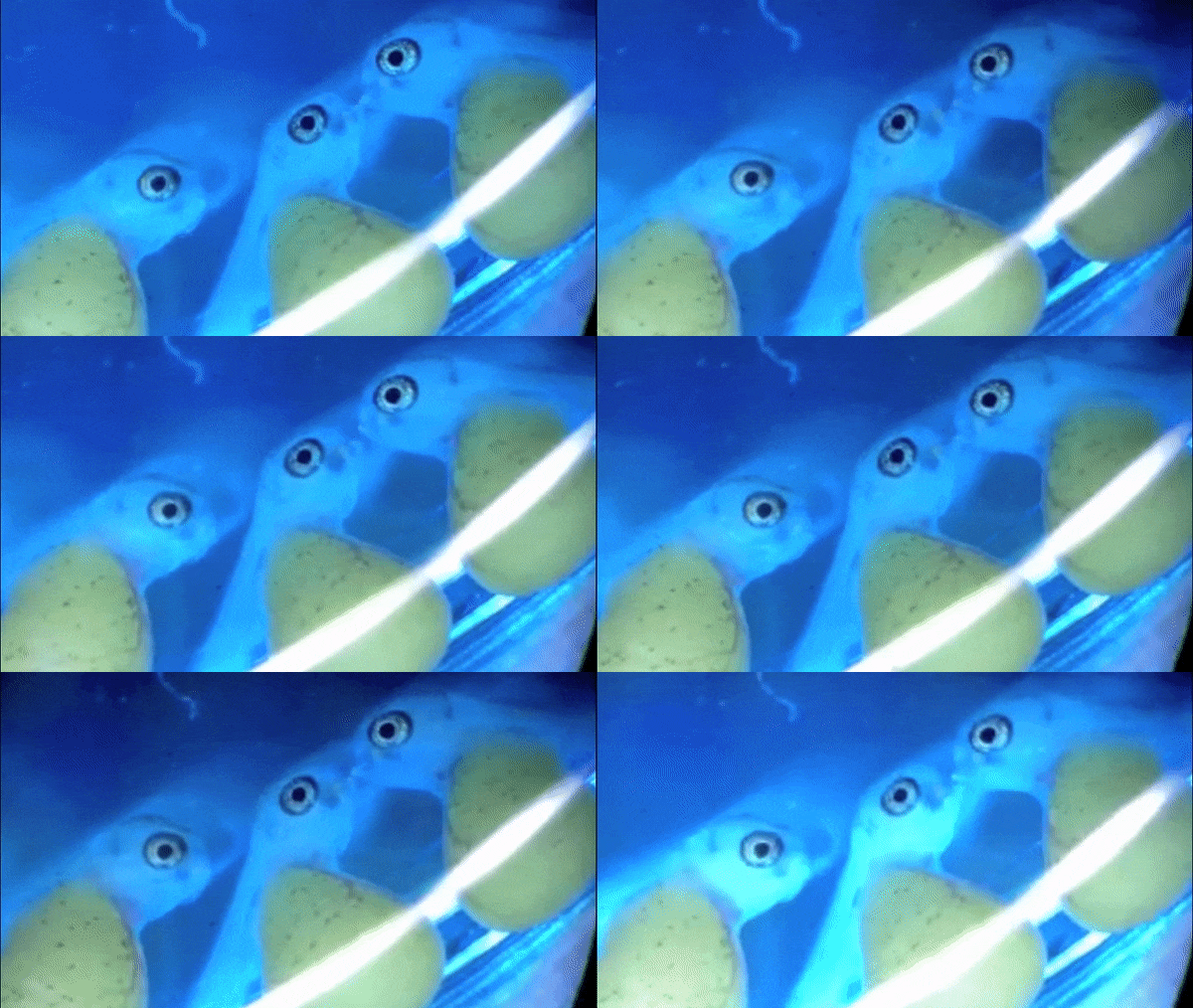
Selfie-takers are likely familiar with the facial expression known as the "fish gape" — a neutral face with unfocused eyes and slightly parted lips. But when gaping occurs in young fish — as they repeatedly open and close their mouths — they're not doing it for the camera. Rather, this behavior strengthens the growing bones in the animals' faces, and the final skull shape depends on the flexing speed of their jaws, according to a new study.
Study co-author R. Craig Albertson, an associate professor in the Biology Department at the University of Massachusetts Amherst, has worked with cichlids — small freshwater fish — for two decades. He was well-aware of this somewhat puzzling activity in the young fishes, but he never paid much attention to it, he told Live Science. As a geneticist, he evaluated fishes' development based on their genes and generally disregarded anything that wasn't encoded in the genome, "especially weird behaviors," he explained.
Albertson said it wasn't until study co-author Yinan Hu, a postdoctoral fellow in the Biology Department at Boston College, pointed out how strange this behavior really was, that Albertson realized the true oddness of the cichlids' "fish gape" — which some fish performed as much as 200 times per minute. [Photos: The Freakiest-Looking Fish]

"He went away and came back a day later and said, 'I don't think that's what they're doing,' Albertson told Live Science. "Because, if you look at the literature it's pretty clear — respiration in early larval fishes occurs through the skin, via osmosis."
And that prompted the scientists to investigate the fishes' gaping in greater detail, Albertson explained.
Variety in larval cichlids' skull development was already well-documented; young fish in some species build up more bone mass early in their growth cycle, while fish in other species accumulate less bone mass in the skull and build it up later in the cycle. These differences were previously thought to be genetic, but the scientists now questioned whether that variation might be linked to the larval fishes' gaping, which vigorously works their jaw muscles as their skulls take shape, Albertson told Live Science.
First, the researchers compared gaping behavior in species with different bone-growth cycles and amounts of skull-bone mass. The scientists found that the fish with more bone mass gaped faster than the species that accumulated less bone in their skulls. That was "pretty compelling," Albertson said, but the scientists needed to conduct experiments to be sure there was a connection.
Get the world’s most fascinating discoveries delivered straight to your inbox.
"Can we experimentally make fast-gaping species gape slower? And what does that do to the bone?" Albertson said. "And can we make slow-gaping species gape faster, and what does that do to the bone?"
In both cases, changes to the fishes' gaping speed affected how much bone mass the fish added to their skulls, and how quickly the bone mass accumulated, the scientists found.
"It tracked beautifully," Albertson said. "When we slowed down gaping in the fast-gaping species, the bone development slowed down. And when we increased gaping in the slow-gaping species, we increased bone development."
Facial form is a complicated genetic trait, meaning that it isn't controlled by any single gene, but rather by the combined activity of many genes, Albertson explained. But less than 50 percent of the variations within complicated traits like facial shape can be explained by genetics, he said.
"Where is the other variation coming from? This study shows that you have these emergent properties that arise due to a seemingly trivial behavior," Albertson said.
"Modulating this trivial behavior can have an influence on skeletal form — that's a connection we geneticists wouldn't normally make."
The findings suggest that behavior and environment can operate hand in hand with an organism's DNA to determine how variations in complicated traits emerge, the scientists said. For geneticists, examining the genome in an environmental context could provide a more complete picture of how animals develop and evolve, Albertson said.
"We're starting to think about the environment as an important factor that influences how genes are expressed and how the genome unfolds to give us an organism with a particular shape," Albertson told Live Science.
"My hope is that this study will help contribute to that," he said.
The findings were published online yesterday in the journal Proceedings of the Royal Society B.
Original article on Live Science.

Mindy Weisberger is a science journalist and author of "Rise of the Zombie Bugs: The Surprising Science of Parasitic Mind-Control" (Hopkins Press). She formerly edited for Scholastic and was a channel editor and senior writer for Live Science. She has reported on general science, covering climate change, paleontology, biology and space. Mindy studied film at Columbia University; prior to LS, she produced, wrote and directed media for the American Museum of Natural History in NYC. Her videos about dinosaurs, astrophysics, biodiversity and evolution appear in museums and science centers worldwide, earning awards such as the CINE Golden Eagle and the Communicator Award of Excellence. Her writing has also appeared in Scientific American, The Washington Post, How It Works Magazine and CNN.