













Ancient 'Unicorn' Fly Had Five Eyes
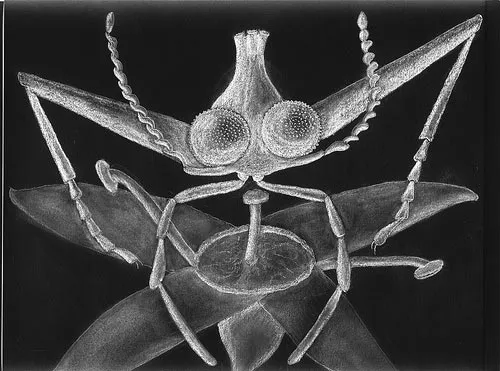
An ancient fly sporting a horn on its head topped with three eyes would have easily seen predators coming where it lived in the jungles of what is now Myanmar some 100 million years ago.
The fly was also equipped with a pair of large compound eyes, similar to those found in today's insects, for a grand total of five peepers.
A specimen of this bizarre-looking insect had been preserved in Burmese amber and was discovered in a mine in the Hukawng Valley of Myanmar. The amber dated back some 97 million to 110 million years ago. Back then, the gooey tree sap would have flowed over the fly before hardening and preserving its features in lifelike detail, the researchers say.
The newfound species, now called Cascoplecia insolitis, gives scientists more details about ancient ecosystems and the creatures that inhabited them.
"No other insect ever discovered has a horn like that, and there's no animal at all with a horn that has eyes on top," said researcher George Poinar, Jr., a professor of zoology at Oregon State University who just announced the newfound species in the journal Cretaceous Research.
The horn and triple-eye set would have given the fly visual prowess in its forest habitat. "I think the horn was to raise up the three simple eyes, which would have made it easier to detect approaching danger," Poinar told LiveScience, adding that the danger may have come from predators that included cockroaches, predator bugs, preying mantids and lizards that lived in the ancient Burmese forest.
The fly showed other freaky features, including antenna with S-shaped segments, unusually long legs that would have helped it crawl over flowers, and tiny vestigial mandibles that would have limited it to nibbling on very tiny particles of food.
Get the world’s most fascinating discoveries delivered straight to your inbox.
Pollen grains found on the fly's legs suggest the insect mostly relied on flowers for food. "It was probably a docile little creature that fed on the pollen and nectar of tiny tropical flowers," Poinar said.
And the oddball may have been in good company when alive, during the age of the dinosaurs.
"This was near the end of the Early Cretaceous when a lot of strange evolutionary adaptations were going on," Poinar said. "Its specialized horn and eyes must have given this insect an advantage on very tiny flowers, but didn't serve as well when larger flowers evolved. So it went extinct."
He added, "This 'unicorn' fly was one of the oddities of the Cretaceous world and was obviously an evolutionary dead end.
Jeanna Bryner is managing editor of Scientific American. Previously she was editor in chief of Live Science and, prior to that, an editor at Scholastic's Science World magazine. Bryner has an English degree from Salisbury University, a master's degree in biogeochemistry and environmental sciences from the University of Maryland and a graduate science journalism degree from New York University. She has worked as a biologist in Florida, where she monitored wetlands and did field surveys for endangered species, including the gorgeous Florida Scrub Jay. She also received an ocean sciences journalism fellowship from the Woods Hole Oceanographic Institution. She is a firm believer that science is for everyone and that just about everything can be viewed through the lens of science.