













Minuscule Motor Runs on Sunlight
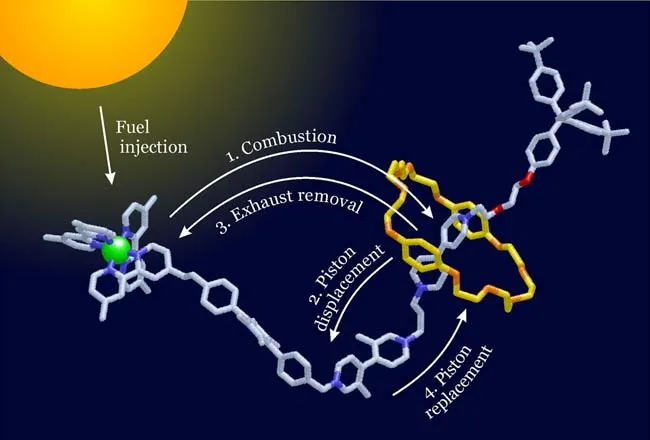
Scientists have developed tiny four-stroke engines that run on sunlight.
The nanomotors--so small that 3.8 million of them lined up end-to-end would barely span the width of a penny--generate absolutely no waste.
Each little motor is just 5 nanometers in length, macaroni-like in shape, and has a ringed structure at one end that moves back-and-forth like the pistons under your car's hood.
Energy, in the form of photons from sunlight, excites one end of the molecule, which sets off a four-step process. Electrons are transferred along the molecule until they reach the ring structure, causing it to slide 1.3 nanometers forward on the molecule.
As the electron continues its path, it reaches a section that recycles it back to the beginning. This causes the molecule to "reset," and the ring returns, piston-like, to its original position.
The whole process takes about 100 microseconds.
Each step is similar to the mechanical functions of the four-stroke engine that powers a car down the road--fuel injection and combustion, piston displacement, exhaust removal, and piston replacement.
Get the world’s most fascinating discoveries delivered straight to your inbox.
Except in this case, the exhaust is an electron, not smog-producing pollutants.
The molecule, called rotaxane, forms naturally. It's also autonomous, meaning that it will continue operating as long as energy is available.
It can work with others, or function all by itself. It can be driven at high frequency, and in mild environmental conditions it is quite durable, staying stable for at least 1,000 cycles.
While the nanomotor is less efficient than some fuel-powered engines--it has an efficiency of only 2 to 12 percent--the researchers point out that it doesn't need refueling and that sunlight is free.
The work is detailed in today's online edition of the Proceedings of the National Academy of Sciences.
- Strong Molecule-Sized Springs Discovered
- The World's Smallest Motor
- Tailpipe Test: Study Finds Worst Polluters
- Less Pollution on City Sidewalks than Streets
- Image Gallery: Micromachines