













Why Belief in Witchcraft Can Do Harm

.jpg)
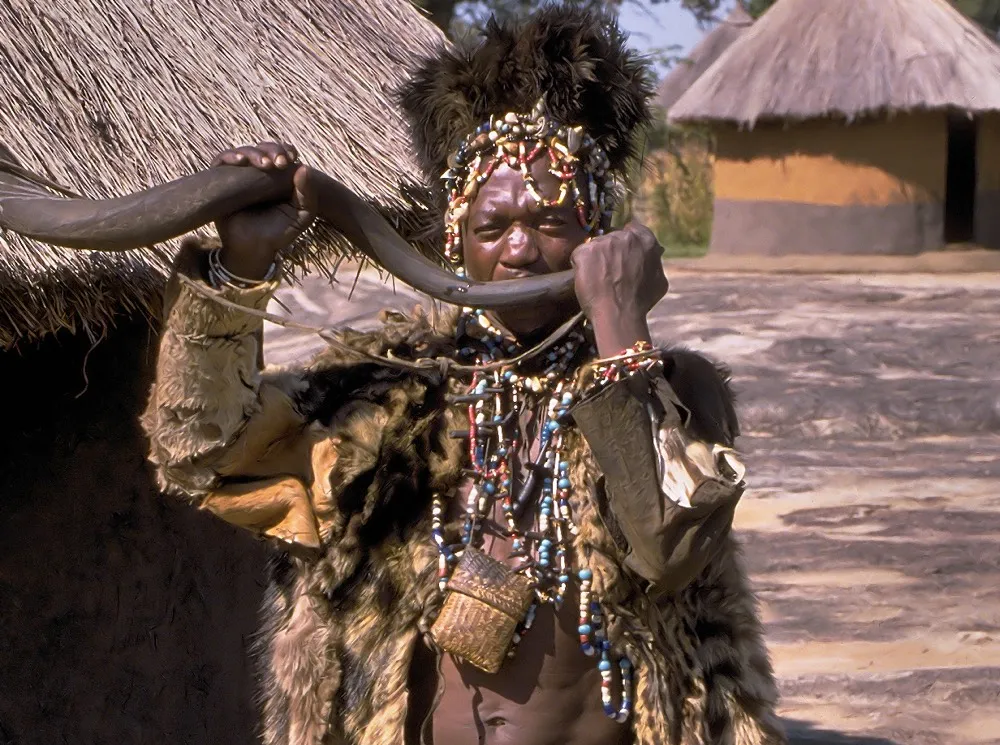
Belief in witchcraft is linked to a lack of trust for people in sub-Saharan Africa, new research finds. And that lack of social trust may be a barrier to economic development in struggling nations.
In regions where witchcraft belief is high, people are less likely to trust others, including their family, neighbors and local institutions, American University economist Boris Gershman reports in the May issue of the Journal of Development Economics. "What's more, the children of immigrants from countries with high prevalence of witchcraft beliefs are more distrusting than children of immigrants from other countries," Gershman found, suggesting that such beliefs may contribute to the formation of persistent antisocial attitudes.
"Economists and other social scientists have found a positive role of things like trust and cooperation in fostering business transactions, economic growth, trade and a variety of positive socioeconomic outcomes," Gershman told Live Science. "If witchcraft beliefs indeed contribute to the erosion of social capital, this is the channel through which they may adversely affect economic development." [The Truth About 13 Interesting Superstitions]
Witchcraft and trust
Gershman's analysis focused on data drawn from a Pew Forum on Religion and Public Life survey conducted in 2008 and 2009 with more than 25,000 people in 19 sub-Saharan countries. The surveys revealed that about 57 percent of respondents believed in witchcraft.
Local beliefs in witchcraft vary, Gershman wrote, but the common thread is that people believe that misfortune (and disease, including HIV) are the result of malevolent spells cast by others. Case studies across sub-Saharan Africa and in other societies with witchcraft beliefs find that these beliefs spread fear in two ways, Gershman said. First, people may fear being bewitched. Second, and possibly more frightening for many, is the fear of being accused of witchcraft, which can sometimes lead to murder. These fears can prevent people from cooperating with one another.
"For example, in one case, people were saying they refuse to provide food assistance to their neighbors, because they were fearing that if something goes wrong, if their neighbors get sick, they were fearing witchcraft accusations," Gershman said. The more common witchcraft beliefin a region, the less likely residents were to engage in charitable giving, Gershman found.
Gershman's analysis controlled for demographic and historical factors that might influence both witchcraft belief and trust, but the results are still correlational. They can't prove that witchcraft belief directly makes people less trusting. But combined with ethnographic case studies, the new research bolsters the idea that witchcraft beliefs really do breed distrust, he said. However, there is likely a feedback loop at play.
Get the world’s most fascinating discoveries delivered straight to your inbox.
"I think it's quite likely that there is this self-reinforcing relationship between witchcraft beliefs and accusations and low social capital," Gershman said, using economics lingo for networks of trusting relationships. "Witchcraft beliefs and accusations erode trust, and eroded trust makes it more likely that witchcraft accusations will continue." [What's Witchcraft? 6 Misconceptions About Wiccans]
About 70 percent of people in the Pew survey said that one "can't be too careful" when dealing with others, picking that answer over "most people can be trusted." The variation in witchcraft belief accounted for about 7 percent of the variation in trust within countries.
The cost of witchcraft
Notably, other superstitious beliefs were not linked with trust, Gershman found. Believing in angels, miracles, shamans or taking a literal view of religious concepts like heaven or hell didn't correlate with people's trust levels.
The confluence of witchcraft and religious belief was somewhat complex, however. The vast majority of respondents — well over 90 percent — identified as Christian or Muslim, Gershman said. But in both religious groups, around 60 percent of people said they also believed in witchcraft.
"What we see is obviously a coexistence of what we think of as classical religion and local beliefs," Gershman said.
There's a strong body of research suggesting that religions with high, moralizing gods promote cooperation, Gershman said. His study hints at the converse: Traditional belief in witchcraft stifles cooperation.
There may be reasons why witchcraft beliefs persist, Gershman said. They can act as an equalizing agent in societies without a welfare state or any mechanism for redistributing wealth; if a person gets too high and mighty, his fellow villagers might accuse him of witchcraft and strip him of his assets. But the survey and ethnographic data suggest that this comes at a high cost to development, Gershman said.
The results would likely apply to other societies where witchcraft beliefs are prevalent, he said. In another analysis, Gershman used data from 186 preindustrial societies around the world and found that those in which witchcraft was seen as an important cause of disease were also those in which parents encouraged toughness and aggression over trust, generosity and honesty. This may be an effort to prevent kids from being either witchcraft victims or alleged witches, Gershman said. A look at another round of data from the European Social Survey revealed that the children of immigrants to Europe from witchcraft-believing areas were less trusting than children of immigrants from elsewhere, bolstering the link between witchcraft belief, parenting and trust.
Witchcraft belief is something that international aid agencies need to take into account when planning economic development programs, Gershman said.
"Imagine you provide people with some new technology and some people adopt it and other people don't, or some people are more successful than others, which creates a disparity in harvest," Gershman said. "This, for a society in which witchcraft beliefs are prevalent, is a possible situation for conflict and accusations."
Follow Stephanie Pappas on Twitter and Google+. Follow us @livescience, Facebook & Google+. Original article on Live Science.

Stephanie Pappas is a contributing writer for Live Science, covering topics ranging from geoscience to archaeology to the human brain and behavior. She was previously a senior writer for Live Science but is now a freelancer based in Denver, Colorado, and regularly contributes to Scientific American and The Monitor, the monthly magazine of the American Psychological Association. Stephanie received a bachelor's degree in psychology from the University of South Carolina and a graduate certificate in science communication from the University of California, Santa Cruz.