













Animal Sex: How Platypuses Do It

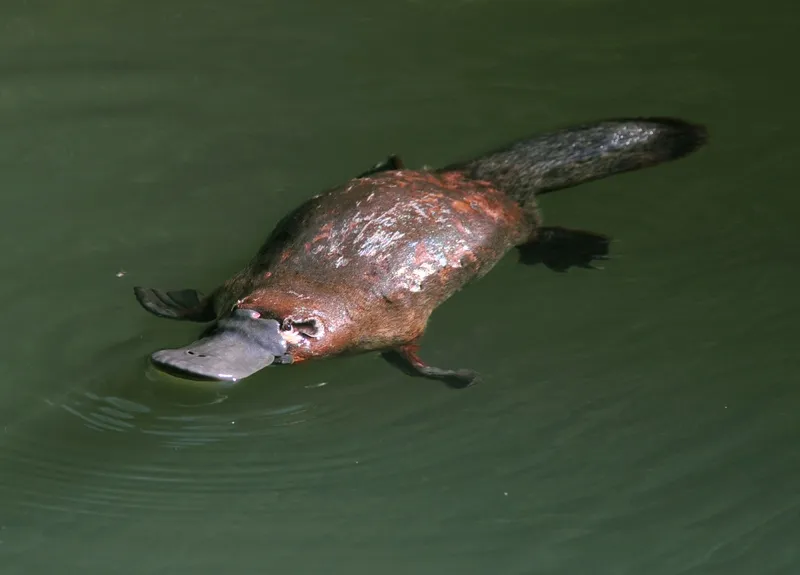
With the bill and webbed toes of a duck, tail of a beaver and body of an otter, platypuses are easily one of the strangest-looking animals on the planet. But are the mating behaviors of these mammals just as odd as their appearance?
As the only living member of the taxonomic family Ornithorhynchidae and genus Ornithorhynchus, the platypus (Ornithorhynchus anatinus) is a unique animal that lives throughout Tasmania and the eastern coast of Australia.
Duck-billed platypuses are generally solitary animals, especially the males, which set up territories in rivers, lagoons and streams. The different home ranges of males may overlap, but the animals try to avoid each other, possibly even changing their foraging schedule to do so.
"The females are more tolerant and may even choose to nest in the same burrow," Jessica Thomas, platypus keeper at the Healesville Sanctuary in Victoria, Australia, told Live Science. But the mammals have a competitive nature that picks up during the breeding season, and the females may nip each other in the tail with their toothless bill to get them out of their area, she said.
The breeding season begins toward the end of winter and start of spring, with some slight variations between the northern and southern platypus populations. During this time, the males produce venom, which is secreted from the spurs on their hind legs and used to inflict painful injuries on rival males. "Theyactively compete for territories and the females in them," Thomas said.
Little is known about what drives sexual selection in platypuses. Females don't appear to be picky with their choice of mates, and probably assume that the male in their area is the biggest and strongest, Thomas said, adding that the female in the Healesville Sanctuary's captive breeding program will court and mate with any male presented to her.
Adult platypus pairs engage in a courtship ritualthat lasts several weeks and takes place up to six weeks before mating occurs. "It's a bit of a dance," Thomas said. Males will try to court females by biting on the female's tail, but the female will flee if she's not ready. Until that point, she may hang out in the same area and feeding pond as the male, but won't allow him to make physical contact with her.
Get the world’s most fascinating discoveries delivered straight to your inbox.
After the female has decided to accept her potential mate, she will allow him to bite on her tail and she will respond by biting on his tail. "They will then swim in a circle," Thomas said. They will also engage in other aquatic courtship activities, such as diving, rolling sideways together and swimming near each other, sometimes for a few days before finally mating.
To copulate, the male will climb partially on to the female's back, and curl his tail under her abdomen to bring their respective cloaca (waste and reproductive orifice) close together. The male will then insert his penis, which is hidden in his cloaca, into the female's cloaca for fertilization — this process can take up to 10 minutes, Thomas said.
After mating, the female will ignore all other mating attempts during that breeding season, and the male may go on to find other females to mate with.
Interestingly, the platypus is one of only two types of mammals (the other being the echidna) that lay eggs.
Follow Joseph Castro on Twitter. Follow us @livescience, Facebook & Google+.
