













Cows Have Strange Sixth Sense

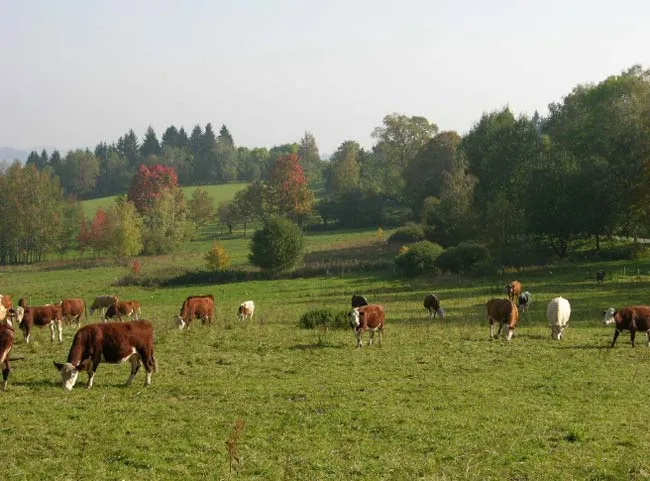
A study of Google Earth satellite images has revealed that herds of cattle tend to face in the north-south direction of Earth's magnetic lines.
Staring at cows may not equal the thrill of spotting celebrities in public or rubbernecking at car accidents, but the researchers found nonetheless that our bovine friends display this strange sixth sense for direction.
Their field observations of red and roe deer also showed those animals facing toward magnetic north or south.
"Google Earth is perfect for this kind of research, because the animals are undisturbed by the observer," said Sabine Begall, a zoologist at the University of Duisburg-Essen in Germany and coauthor on the study detailed in the journal Proceedings of the National Academy of Sciences.
Wind and time of day did not offer better explanations for why 8,510 cattle in 308 locations around the world would mostly face north-south. Shadows suggested that many of the images were taken on cloudless, sunny days, so Begall's group also factored in direct ground observations of cattle herds.
A strong wind or sunlight on a cold day have typically proved more the "exceptions to the rule" that might cause large animals to face away from magnetic north-south.
The data on 2,974 deer came from direct ground observations and photos in the Czech Republic. Researchers also examined fresh beds left by resting deer in the snow, where the animals had sought shelter deep in the forest away from the wind.
Get the world’s most fascinating discoveries delivered straight to your inbox.
Both cattle and deer faced a more magnetic north-south direction rather than geographic north-south, (Earth's magnetic poles do not line up perfectly with the North and South Poles).
Previous research has shown that animals such as birds, turtles and salmon migrate using a sense of magnetic direction, and small mammals such as rodents and one bat species also have a magnetic compass.
Begall and fellow researchers became interested in seeing if larger mammals possessed a similar magnetic sense, following up on coauthor Hynek Burda's work on African mole-rats.
"Our first idea was to study sleeping directions of humans (e.g. when doing camping), but there are too many constraints," Begall told LiveScience. "So, the idea arose to look for other large mammals like cattle, and Hynek was fascinated when he recognized that cattle could be found on Google Earth satellite images."
Google Earth's convenience also came with some downsides. The researchers had to estimate the date, time of day, temperature and wind direction, and could not distinguish between head and rear for many of the cows because of low image resolutions.
However, the researchers suggest that the finding of large animals' sense of magnetic direction could raise other agricultural questions, such as whether keeping cows in barns facing east-west might affect milk production.
- Video - Bird Radar
- Amazing Animal Abilities
- How Do Birds Navigate?
