













Most Evangelical Christians Say Science and Religion Can Coexist

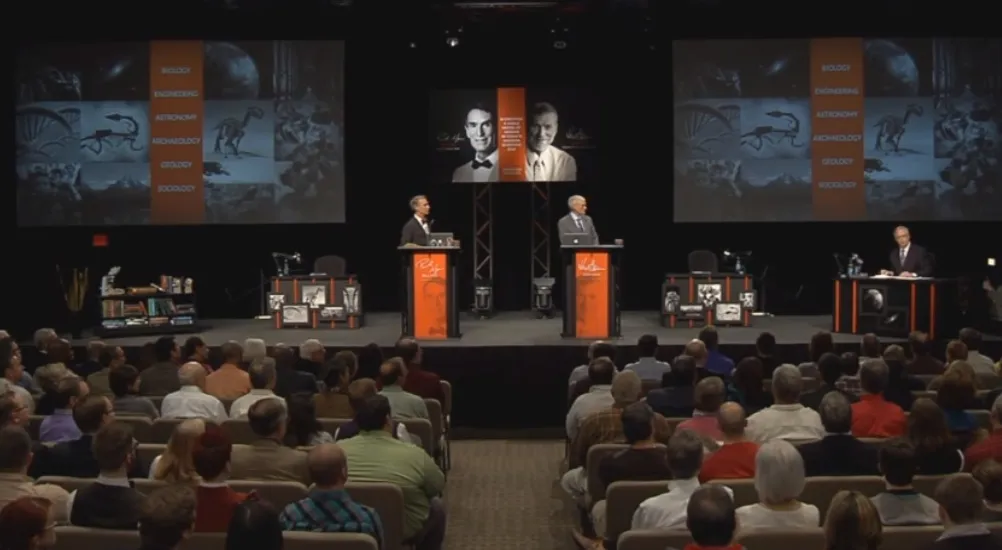
Never mind the outspoken Christian leaders who reject the Big Bang and human evolution; nearly 70 percent of rank-and-file evangelicals in the United States say they don't see religion and science as being totally at odds, a new survey found.
"Although many politicians and the media at large portray evangelicals as distrustful of science, we found that this is more myth than reality," Elaine Howard Ecklund, a sociologist at Rice University who orchestrated the survey, said in a statement.
Among evangelical Christians, about 48 percent said they see science and religion as complementary to one another, while 21 percent think science and religion refer to different aspects of reality and see them as entirely independent of one another, the survey found. [Creationism vs. Evolution: 6 Big Battles]
Still, the share of evangelical Christians who think religion and science are in conflict (and see themselves on the side of religion) is 29 percent — more than double the figure in the general population (14 percent), the study found. Overall, 38 percent of adults in the United States view religion and science as complementary, while 35 percent view science and religion as separate.
Though a majority of evangelicals don't see science and religion in conflict, many of them still believe in ideas that science doesn't support. For example, about 43 percent of evangelical Christians (compared with about 22 percent of the general population) believe that God created the universe and all life inside it within the last 10,000 years, according to the survey. (By studying the oldest light in the cosmos, scientists, meanwhile, have determined that the universe is about 13.8 billion years old.) And 42 percent of evangelical Americans support teaching creationism in schools instead of evolution, compared with about 18 percent of the general population who said the same.
Ecklund and her colleagues think the perception that evangelical Christians are unfriendly to science might hinge on just a few of these hot-button issues, like creationism. The evangelicals who saw science and religion as incompatible often fixated on human origins, the study found. One survey participant who was part of a largely white evangelical congregation in Houston, Texas, explained this point of view to the interviewers:
"As a Christian, creation — really it's all or nothing. Either the entire Bible's right or it's all wrong. Either everything inside of it is 100 percent accurate, or none of it is. So if creation could be disproven … So just completely take that away, that just devastates my entire way of life, my entire being. … Nobody wants to change. Christians don't want to change, and atheists don't want to change."
Get the world’s most fascinating discoveries delivered straight to your inbox.
Focusing on evolution/creation has also narrowed the conversation about the relationship that religious people have with science, according to Ecklund and colleagues. The perception that evangelical Christians are hostile toward science might only be propagated with events like last year's televised debate between science popularizer Bill Nye and creationist Ken Ham, who believes the Bible's Book of Genesis is a literal description of the creation of Earth, the researchers said. But these heated debates don't necessarily reflect the way average evangelicals think.
Ecklund and colleagues surveyed more than 10,000 adults from across the country about their views on religion and science. They also conducted 315 in-depth interviews with Americans of different faiths. Ecklund presented the findings last week in Washington, D.C., during an American Association for the Advancement of Science (AAAS) conference on religion and science.
Follow Megan Gannon on Twitter. Follow us @livescience, Facebook & Google+. Original article on Live Science.
