













Newfound Frog Has Strange Breeding Habits

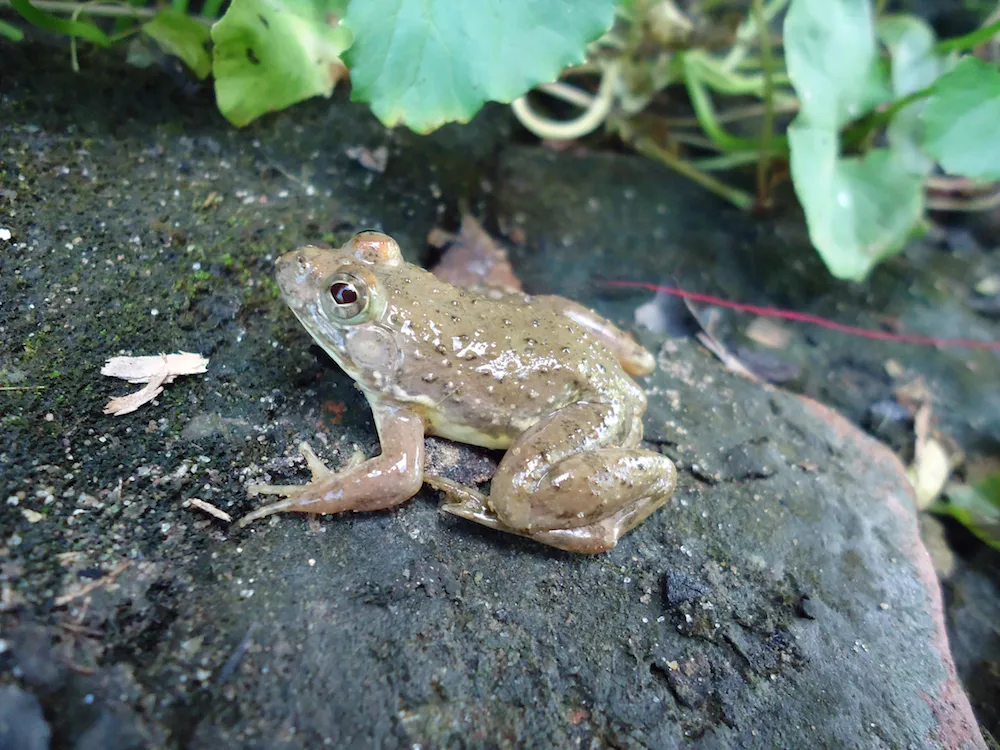
A new species of frog has hopped onto the radar of researchers in Bangladesh. The frogs were discovered after the researchers noticed their unusual breeding habits, according to a new study.
Most frogs have a specific mating season, but researchers found that one frog bred all year long, even in the winter, said study lead researcher M. Sajid Ali Howlader, a doctoral student of biosciences at the University of Helsinki in Finland.
Howlader learned that the frog was named Euphlyctis cyanophlycti, and it was discovered by the German naturalist J. G. Schneider in 1799. But, a detailed study of the frog's genetics, shape and size showed that it was actually an entirely different species from E. cyanophlycti. [Photos: Cute and Colorful Frogs]
The newfound frog's mitochondrial genes are between 5.5 percent and about 18 percent different from other frog species in the same genus, the researchers found. And its grayish-brown and green back, covered with dark, rounded spots, and white underside also look different from E. cyanophlycti, Howlader said.
Female frogs prefer a group of males calling to them rather than a lone male calling by himself, they found. Once the female is ready to mate, she will hop over to the male and make physical contact with him.rAfter observing that the frogs mate all year long, Howlader and his colleagues became experts at describing the amphibian's mating practices.He named the new 1.5-inch-long (3.8 centimeters) frog Euphlyctis kalasgramensis, after the Bangladesh village of Kalasgram, where he first found the frogs.
Further investigations of E. kalasgramensis showed that it eats different types of worms, small crabs, snails, spiders and insects, especially those that harm local crops, Howlader said.Once chosen, the male doesn't waste any time. He immediately jumps on the female's back, clinging to her below the armpits with his forearms, Howlader said. The male uses his hind legs to kick away competing males, and moves with the female to a small, shallow pool of water to spawn.
The researchers found that the frog lives in pools of water that collect in forests and crop fields, which puts it at risk from farming pesticides that pollute water, Howlader said. The frog is also threatened by people who use it as live bait for fishing, and by indigenous people who eat it, he told Live Science.
Get the world’s most fascinating discoveries delivered straight to your inbox.
The study may raise awareness that the frog needs protection, the researchers said.
"Frog[s] originated before 265 million years ago," Howlader said. "The first members of our human family (hominins) evolved about only 6 or 7 million years ago. But the existence of this old member of our world has become threatened by our activities and ignorance."
The findings were published online today (Feb. 4) in the journal PLOS ONE.
Follow Laura Geggel on Twitter @LauraGeggel. Follow Live Science @livescience, Facebook & Google+. Original article on Live Science.

Laura is the managing editor at Live Science. She also runs the archaeology section and the Life's Little Mysteries series. Her work has appeared in The New York Times, Scholastic, Popular Science and Spectrum, a site on autism research. She has won multiple awards from the Society of Professional Journalists and the Washington Newspaper Publishers Association for her reporting at a weekly newspaper near Seattle. Laura holds a bachelor's degree in English literature and psychology from Washington University in St. Louis and a master's degree in science writing from NYU.