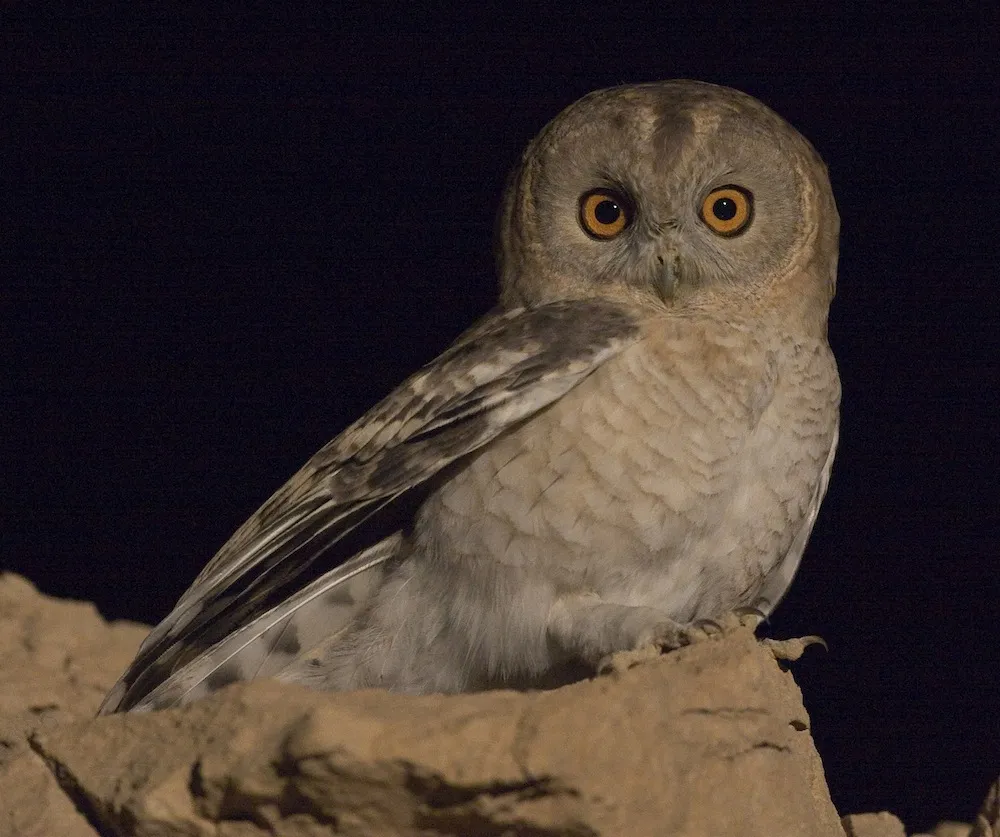
Once mistaken for another species of owl, the golden-eyed "desert tawny owl" is now finally getting its due.
In a new report, researchers examined the plumage and body shape of owl specimens from museums around the world that had previously been thought to be members of a species called Hume's owl. The researchers also analyzed the owls' mitochondrial DNA, and found it was about 10 percent different from that of the Hume's owl, which is properly known as species Strix butleri.
"We reinvestigated it using all techniques available to us, and realized — especially based on the fact that there were massive genetic differences between Hume's type and specimens from elsewhere — that it was pretty obvious that there were two species involved," said Guy Kirwan, a research associate at the Field Museum of Natural History in Chicago and co-author of the new report. [Whooo's in There? Images of Amazing Owls]
The researchers named the new owl Strix hadorami, after the project's brainchild, renowned ornithologist Hadoram Shirihai.
The groundwork for the mix-up began in 1878, when Allan Hume, a famous British ornithologist who was working in India, received an owl specimen from an acquaintance named Edward Butler. That owl, which came to be known as Hume's owl (S. butleri), was likely found in present-day Pakistan.
But coincidentally, another ornithologist of the time, named Henry Tristram, had already collected an owl with similar markings.
"Hume had named his bird, and Tristram thought [his owl] was the same thing," Kirwan said.
Sign up for the Live Science daily newsletter now
Get the world’s most fascinating discoveries delivered straight to your inbox.
But then, more than a century later, a new look at the owls shook things up.
The renowned ornithologist Hadoram Shirihai visited the Natural History Museum in Tring, England, while working on a book in 1985. Shirihai noticed some of the Hume's owl specimens in England looked different from each other, and also different from the Hume's owls he had seen in Israeli museums and in the wild.
The desert tawny owl nests in crevices found in in rocky deserts with ravines.
Shirihai planned to rename the Israeli owls, but other commitments prevented him from ever doing so, Kirwan said. In the new paper, the researchers took a more detailed approach to looking at the owl's differences than Shirihai had taken in making his observations.
Curiously, another group of ornithologists recently named another new species of owl in the Middle East, in a study in the 2013 journal Dutch Birding. Those researchers reported observing an owl that looked similar to S. butleri, but had a different vocalization. They named this owl Strix omanensis after Oman, the country in which they had seen the animal (the researchers chose not to capture a specimen).
In fact, they may have just mistakenly renamed Hume's owl, Kirwan said.
"Everyone now accepts that Hume's owl contains two species," he said. "The Dutch team provided a very important building block in the process of discovering that there were two species, but made a mistake, in our view, in [determining] which one needed to be named."
He added, "We believe that we have now named the right new species."
This new owl, the desert tawny owl, has light brown feathers on its back and sand-colored feathers on its underside, and lives in Middle Eastern areas such as Egypt, Israel, Jordan, Oman, Saudi Arabia and the Sinai Peninsula. It measures about 12 inches (30 centimeters) from head to tail, and weighs 0.3 pounds to 0.5 pounds (140 grams to 220 grams).
The owl typically lives in desert canyons and ravines, and nests in holes and crevices found in cliffs. Like in other owls, the females are larger than the males. Both eat rodents and insectivores, such as gerbils, mice and shrews, along with arthropods such as scorpions, grasshoppers and beetles, according to an analysis of the owls' pellets.
Laura is the managing editor at Live Science. She also runs the archaeology section and the Life's Little Mysteries series. Her work has appeared in The New York Times, Scholastic, Popular Science and Spectrum, a site on autism research. She has won multiple awards from the Society of Professional Journalists and the Washington Newspaper Publishers Association for her reporting at a weekly newspaper near Seattle. Laura holds a bachelor's degree in English literature and psychology from Washington University in St. Louis and a master's degree in science writing from NYU.