













Insects Wear Tiny Spacesuits, for Science

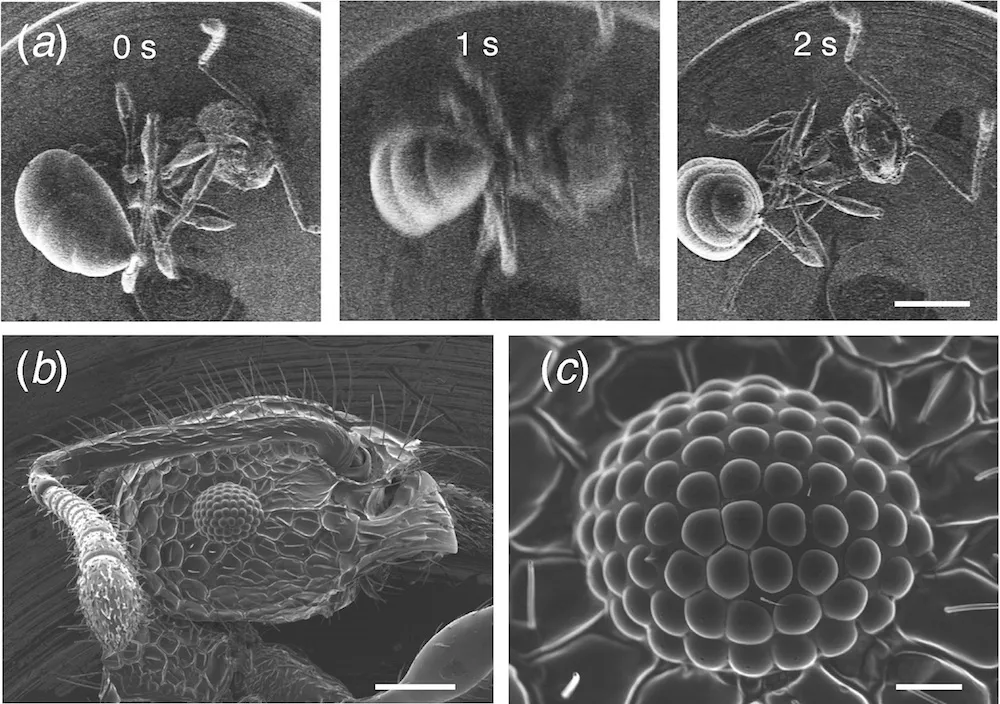
What's the best way to keep an insect from exploding in a powerful vacuum? Wrap it in a tiny spacesuit, of course.
Scanning electron microscopes (SEM) provide incredibly detailed images of biological specimens, but the instruments have not been able to image living organisms because of the powerful vacuum environment required.
But now, a team of researchers has developed a way to image mosquitoes and other insects in an SEM, by wrapping them in a substance that keeps the organisms alive, without interfering with the imaging process. [See video of bugs wearing tiny spacesuits]
An SEM creates images by scanning a focused beam of electrons across a specimen. Researchers use the technology to study the structure or composition of samples. The instrument is so powerful it can produce images of features that are only billionths of a meter wide.
But to prevent the electrons in the beam from scattering, the scanning must be done in a vacuum. And since biological specimens consist of mostly water, which evaporates in a vacuum and destroys surrounding structures, traditional SEM imaging requires killing and dehydrating the specimens first.
In their study, the research team found a way to image living organisms — namely, insects — by coating them in a very thin, flexible membrane that the researchers call a "nanosuit."
"The thickness is only 50 to 100 nanometers" — roughly one-thousandth the width of a human hair — "and covers the whole body of each organism," said Takahiko Hariyama, a biologist at Hamamatsu University School of Medicine in Japan and lead author of the study, which appears tomorrow (Jan. 28) in the journal Proceedings of the Royal Society B.
Get the world’s most fascinating discoveries delivered straight to your inbox.
The researchers imaged several different kinds of insects, including the mosquito Culex pipiens molestus. (This insect is also known as the London Underground mosquito, because it attacked London residents who were taking refuge in the Underground rapid transit system during Nazi bombing in World War II.) The team also imaged a species of shining leaf beetle, Lilioceris merdigera, and the beach-dwelling crustacean Talitrus saltator.
Getting the insects into the nanosuits was easy, Hariyama told Live Science. Researchers simply dipped the insects into the diluted surfactant, a substanceused to prepare specimens for the SEM, or added a tiny drop of the surfactant and removed the excess with a dry piece of paper, he said. Then, the scientists shone the electron beam or plasma on the insect, he added.
The resulting nanosuits were hard on the outside and soft on the inside, and could repair themselves if the insects' movement broke the surfaces. The researchers were able to take detailed images of the insects without harming the creatures, Hariyama said, adding that almost all of the insects in the study survived the imaging.
In ongoing work, Hariyama and his team plan to analyze the DNA of the insects after the imaging, to see if the nanosuits caused any lasting health issues.
Follow Tanya Lewis on Twitter. Follow us @livescience, Facebook & Google+. Original article on Live Science.
