













Flashy Experiment Almost Creates Lightning

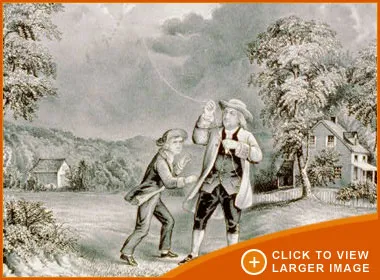
Hailed by historians as the \"First American,\" Franklin shaped the American Revolution and was an intellectual leader of the \"Enlightenment.\" Noted for his ingenuity and diversity of interests, he invented bifocals, the Franklin stove, the lightning rod, the glass harmonica, swimfins, and is famous for his experiments with electricity.
Scientists have triggered the electrical precursors to lightning with lasers aimed at thunderstorms for the first time, a new study reports. In a modern-day version of Benjamin Franklin's famous kite experiment, the scientists placed a mobile laser at the top of New Mexico's 10,500-foot South Baldy Peak and shot laser pulses at two passing thunderstorms, generating electrical activity in the clouds. Franklin proposed an experiment to use a key attached to a kite to trigger lightning in a storm, though it is uncertain whether he performed the experiment himself. He used his knowledge of electricity to invent the lightning rod, which can take a lightning strike that might otherwise destroy a building and conduct it into the ground. No full-blown lightning strikes stretching from the air to the ground were actually generated in the New Mexico experiment, but it did create "small local discharges" of electricity within the clouds, the researchers report in the journal Optics Express. The work represents a flash forward in manmade lighting. "This was an important first step toward triggering lightning strikes with laser beams," said study leader Jérôme Kasparian of the University of Lyon in France. "It was the first time we generated lightning precursors in a thundercloud." The laser pulses form large numbers of plasma filaments, or ionized channels of molecules in the air, that act like conducting wires extending into the thundercloud. The lasers used by Kasparian's team generated small local electric discharges near the plasma channels, but the discharges were not powerful enough to create long-lived filaments that could conduct lightning all the way to the ground. The team is currently looking at increasing the power of the laser pulses to generate more lightning. Lasers aren't the first method scientists have used to create manmade lighting. In the 1970s, scientists shot small rockets that spooled long wires connected to the ground into thunderclouds to trigger lightning strikes. Scientists have also created ball lightning, floating electrical orbs, in the lab using a regular microwave oven. Deliberately triggering lightning strikes can help scientists understand the underlying mechanisms of lightning formation and allow engineers to test the lightning-sensitivity of airplanes and power lines. The research was funded by the CNRS (National Center for Science Research in France), DFG (German Research Foundation) and the French and German ministries of foreign affairs.
- 101 Amazing Earth Facts
- The Science of Lightning
- Images: Electric Earth
Get the world’s most fascinating discoveries delivered straight to your inbox.
