













Climate Change Takes Bloom Off Wildflowers

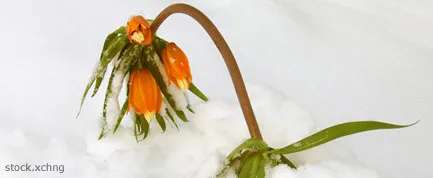
Editor's Note: This story has been corrected to state that the increased incidence of frost-killed flower buds was based on data collected from 1999-2006, not 1999-2000 as originally written.
Fewer flowers may grace the slopes of the Rocky Mountains as global warming's earlier springtimes make blooms more vulnerable, a new study suggests.
David Inouye of the University of Maryland used data gathered in the Rockies from 1973 to the present to see how earlier spring thaws were affecting three flowers common to the mountain range.
Larkspur (Delphinium barbeyi) has blue star-shaped, hooded blooms on thin stems that can grow anywhere from 3 feet to 6 feet tall. Aspen fleabane (Erigeron speciosus) has small, purple daisy-like flowers with yellow centers. Aspen sunflowers (Helianthella quinquenervis) have bright yellow flowers and grow in open, grassy areas.
All three species grow around an altitude of 9,500 feet, where winter snows can be as much as 8 feet deep. As Earth's climate has warmed in the past century, a combination of lower snowfall amounts and warmer springs has caused the snow to melt earlier. For many wildflowers, an earlier snowmelt spurs an earlier growing season.
Once the snow is gone, flowers form buds and get ready to bloom. But cold air masses can still move through the region at night, with frosts occurring as late as June.
The data indicates that frost events have increased in the past decade. From 1992 to 1998, an average of 36.1 percent of aspen sunflower buds were frosted. But from 1999 to 2006, that average was 73.9 percent.
Get the world’s most fascinating discoveries delivered straight to your inbox.
These frosts don't kill the plants, but do make them unable to seed and reproduce. People may not notice the flowers' plight because all three species are perennials (a given plant survives to bloom year after year) and therefore long-lived. An individual sunflower can live to be up to 75 years old, Inouye said, “but we find that these perennials are not producing enough seeds to make the next generation of plants."
Other species, especially certain types of insects, depend on the flowers for food. Other bugs, in turn, eat those insects. So the loss of seeds and flowers could propagate through the food chain.
“What will replace these colorful flowers? We don’t know,” Inouye said. “But we know that many animals depend upon them, and so the outcome could be quite dramatic.”
- Top 10 Poisonous Plants
- Mystery Solved: How Plants Know When to Flower
- Top 10 Surprising Results of Global Warming

Andrea Thompson is an associate editor at Scientific American, where she covers sustainability, energy and the environment. Prior to that, she was a senior writer covering climate science at Climate Central and a reporter and editor at Live Science, where she primarily covered Earth science and the environment. She holds a graduate degree in science health and environmental reporting from New York University, as well as a bachelor of science and and masters of science in atmospheric chemistry from the Georgia Institute of Technology.