















Entangled 'Photon Triplets' Could Speed Up Telecommunication

Physicists have entangled three particles of light faster than ever, creating triplets that stay connected no matter how far apart they are from one another.
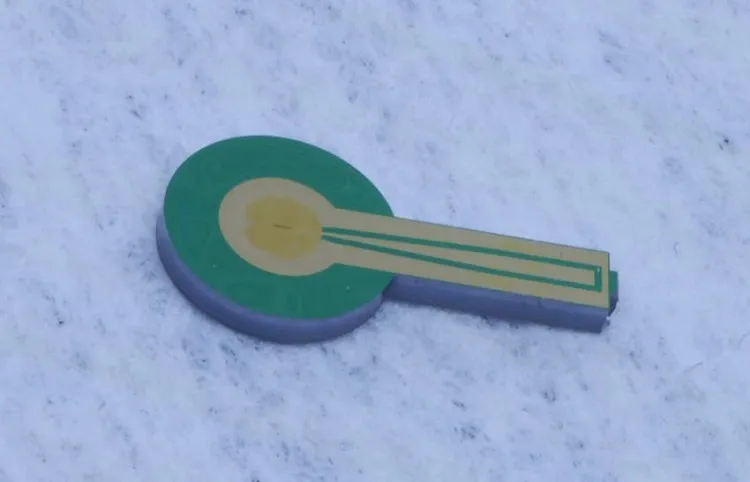
In the bizarre world of quantum mechanics, particles can become entangled so that, even if they are long distances from one another, an action on one will affect the others — a phenomenon that Albert Einstein once called "spooky." In the new study, the researchers were able to record data on so many entangled triplets thanks to a new supersensitive photon detector developed at the National Institute of Standards and Technology (NIST). The new detector allowed the researchers to speed up the experiment, because it could detect photon triplets with a much higher efficiency than older detectors.
The new experiment has implications for quantum computers, which use qubits (quantum particles), rather than 1s and 0s, to store information. Because quantum particles can exist in more than one place at once — a phenomenon called superposition — qubits can store more information than the bits in traditional computers. [How Spooky Quantum Entanglement Works (Infographic)]
Such quantum computers would require multientangled particles, because the more entangled particles they use, the more information they can store and the faster that information can be computed, even compared with such particles being in more than one place at a time. Qubits can exist as either a 1 or a 0 in their superposition state. That means that two entangled qubits could compute four values at once, three qubits could compute eight values at once, and so on. And that's where the new experiment, which generated entangled photon triplets, comes in. (Photons are particles of light.)
"The more entangled photons you have, the more quantum resources you have and the more information you can store," Krister Shalm, a researcher at NIST, told Live Science.
Tangled triplets
Shalm and the team of researchers produced triplet entangled photons in a more stable and more technologically useful state than previous methods did.
Get the world’s most fascinating discoveries delivered straight to your inbox.
The researchers first shot a blue photon through a special crystal that transformed it into two red entangled photons, dubbed "daughter photons," with half the intensity of the first photon. The system then sent one of the daughter photons through a second crystal that created a pair of infrared "granddaughter photons" that became entangled with the daughter photon.
However, quantum entanglement is rare, Shalm said. The two daughter photons only become entangled once out of every billion tries. Once that finally happens, the granddaughter photons from the daughter photon only become entangled with a daughter photon once in a million times. This makes it difficult to study quantum entanglement and apply the phenomenon to things like quantum computing and quantum communication.
The new detector recorded data from the photons 100 times faster than older detectors. The experiment pumped out entangled triplets at a rate of 660 per hour — a big improvement over the seven per hour produced in previous experiments.
Faster communication
The resulting triplet photons generated by the researchers with the new system are right around the wavelengths used in telecommunication, Shalm said. Quantum entanglement is useful in telecommunications, because one photon could be sent to New York, for example, while the other photon is sent to the other side of the world, but the two remain intimately connected and can quickly transfer messages.
However, the experiment's potential application to quantum computing is further off. The setup of the experiment is not scalable, so the huge number of entangled particles needed for quantum computing is still a long ways off, Shalm said. In other words, it's not practical to generate more entangled particles by simply sending each daughter photon through another crystal, where the likelihood of quantum entanglement gets smaller and smaller.
Details of the experiment were published Sept. 14 in the journal Nature Photonics.
Follow Kelly Dickerson on Twitter. Follow us @livescience, Facebook & Google+. Original article on Live Science.
