Steps on the Road to Programmable Matter (Infographic)
Get the world’s most fascinating discoveries delivered straight to your inbox.
You are now subscribed
Your newsletter sign-up was successful
Want to add more newsletters?
Delivered Daily
Daily Newsletter
Sign up for the latest discoveries, groundbreaking research and fascinating breakthroughs that impact you and the wider world direct to your inbox.
Once a week
Life's Little Mysteries
Feed your curiosity with an exclusive mystery every week, solved with science and delivered direct to your inbox before it's seen anywhere else.
Once a week
How It Works
Sign up to our free science & technology newsletter for your weekly fix of fascinating articles, quick quizzes, amazing images, and more
Delivered daily
Space.com Newsletter
Breaking space news, the latest updates on rocket launches, skywatching events and more!
Once a month
Watch This Space
Sign up to our monthly entertainment newsletter to keep up with all our coverage of the latest sci-fi and space movies, tv shows, games and books.
Once a week
Night Sky This Week
Discover this week's must-see night sky events, moon phases, and stunning astrophotos. Sign up for our skywatching newsletter and explore the universe with us!
Join the club
Get full access to premium articles, exclusive features and a growing list of member rewards.
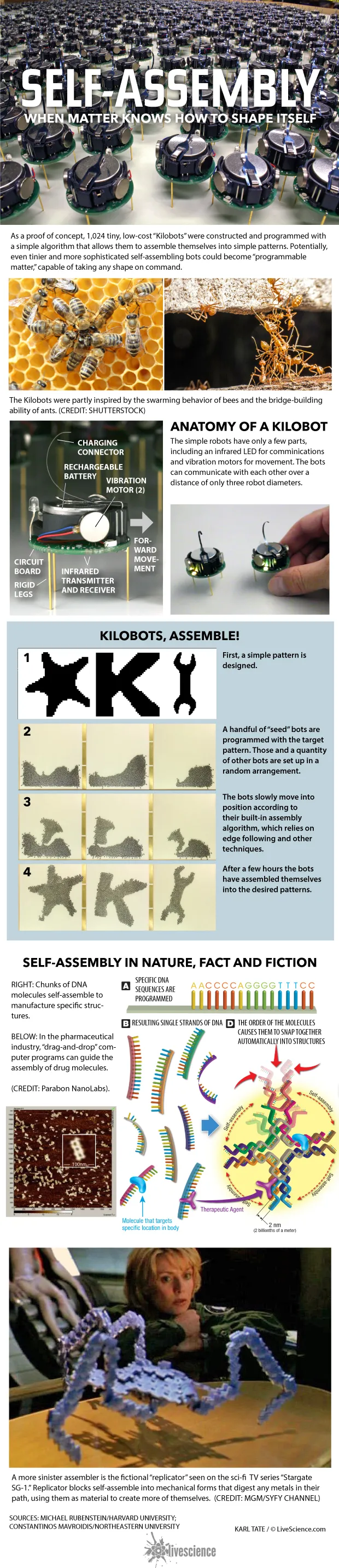
As a proof of concept, 1,024 tiny, low-cost “Kilobots” were constructed and programmed with a simple algorithm that allows them to assemble themselves into simple patterns. Potentially, even tinier and more sophisticated self-assembling bots could become “programmable matter,” capable of taking any shape on command.
The Kilobots were partly inspired by the swarming behavior of bees and the bridge-building ability of ants. The simple robots have only a few parts, including an infrared LED for comminications and vibration motors for movement. The bots can communicate with each other over a distance of only three robot diameters.
For the Kilobot demonstration, first, a simple pattern is designed. A handful of “seed” bots are programmed with the target pattern. Those and a quantity of other bots are set up in a random arrangement. The bots slowly move into position according to their built-in assembly algorithm, which relies on edge following and other techniques. After a few hours the bots have assembled themselves into the desired patterns.
Get the world’s most fascinating discoveries delivered straight to your inbox.