













Even Monkeys Go Ga-Ga over Babies
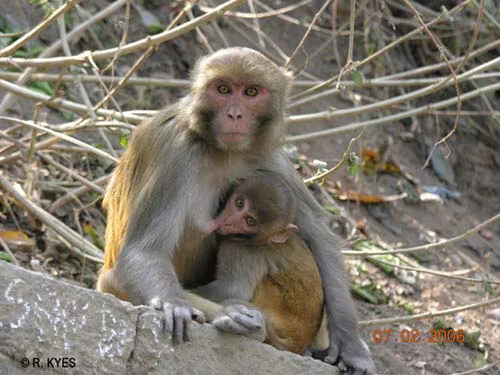
"Awww, isn’t she ad-or-a-ble?"
Nothing makes a person sound more idiotic than the presence of a new baby.
Our voices climb quickly into the stratosphere of the human vocal range and our words squeak out in a way that annoys everyone within earshot.
We also start to babble senseless, often embarrassing, phrases.
"Oooooh, sweetums, lumpkin, cutie-cutie."
Sometimes even the baby shakes its head in disgust.
But something about a baby turns us unto clowns. And it looks like we aren’t the only primates to make such fools of ourselves over small members of our species.
Get the world’s most fascinating discoveries delivered straight to your inbox.
Rhesus monkey females, according to Jessica Whitham of the Brookfield Zoo in Chicago, also make fools of themselves over babies.
Whitham observed 19 adult females living in a large group of monkeys on Cayo Santigao, an island near Puerto Rico. Although Rhesus monkeys are endemic to India, this colony was established years ago and the animals have been subjects of behavioral research ever since.
Rhesus monkeys are seasonal breeders, which means babies are born in a clump and that seems to drive some females to distraction. When a baby is around, adult females wag their tails and emit two particular vocalizations that are directed at the little ones and their mothers
All macaques make soft grunting noises during social interactions, feeding and group movement. The grunt seems to be a generalized macaque phrase that says, "Hey!" In the baby context, females ramp up their grunts and do them over and over, getting more agitated with every syllable.
Around babies, females also make a call called a girney, a whining sound that apparently goes well with a grunt.
Sounding like wheezing, puffing calliopes, females approach the mother or the baby. Although they look rather scary in their excitement, the noises apparently signal, "I'm no threat. I won’t hurt the baby."
Sometimes the females move in and touch or grab the baby, or they groom the mother who might be higher ranking and, under different circumstances, less tolerant.
Other times they grunt and girney when babies wander away from their mothers, which means they are directing the calls to babies alone.
In fact, females reserve most of their girneys for babies, as if this nasal wheeze were a sort of baby talk. But interestingly, mothers don’t girney at their own babies, so in the case of macaques it's grandma, auntie and the neighbors who are doing all the coochie-cooing.
Not every female, macaque or human, likes babies. But for those who do, the attraction is immediate and irresistible. Reassuring noises, and sometimes decent presents, are clearly the best way to get your hands on that baby.
Meredith F. Small is an anthropologist at Cornell University. She is also the author of "Our Babies, Ourselves; How Biology and Culture Shape the Way We Parent" (link) and "The Culture of Our Discontent; Beyond the Medical Model of Mental Illness" (link).
- Video: Jane Goodall's Wild Chimpanzees
- 10 Species Success Stories
- Top 10 Missing Links