













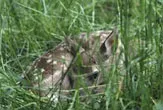
Fawns are keenly tuned to their mothers' voices, but female fallow deer can't recognize their own offspring based on sound alone, a new study finds.
The imbalance is an example of how the type of environment a species lives in affects how parents and offspring communicate, the researchers say.
Using recordings and playbacks in experiments of Swiss fallow deer, the researchers found that adult female deer have distinctive calls, but fawns don't. So even though fawns can distinguish their mother's call from other females, a mother deer can't distinguish its offspring's cry from other fawns.
The researchers speculate that the one-way system developed because deer typically live in environments with abundant cover for newborn fawns, which for weeks after birth are clumsy walkers that are reliant on their mothers for survival.
For the first two to three weeks of life, young fallow deer lie hidden and silent in vegetation. Mothers spend most of their time away from their fawn's hiding places but return every so often to nurse.
To find its offspring, a mother deer approaches the approximate location of where its fawn is concealed and vocalizes. The fawn then walks over for its feeding session. As a final identity check, a mother will often sniff the fawn to make sure it's really hers.
In contrast, the offspring of the closely related reindeer are mobile soon after birth; they can tag along with their mothers and also run away from predators.
Get the world’s most fascinating discoveries delivered straight to your inbox.
Fallow deer and reindeer thus belong to two different groups of ungulates, which biologists call "hider" and "follower" species, respectively, based on the strategies each group uses to avoid predators.
"Our results show that different environmental conditions influence predator avoidance strategies and also affect the evolution of different parental recognition mechanisms," said study team-leader Alan McElligott from the University of Zurich.
The finding is detailed in the September issue of the journal American Naturalist.
- Image Gallery: Creatures of the Wild
- Monkey's Voice Good as Human's for Newborn Babies
- Deer Attacks Woman ... In Her House
- Baby's Cries Hold Health Clues
- Wild New Idea: The Deer Cam