













Got Cavities? Ancient Teeth Reveal Bacteria's Evolution

Ouch! The bacterium that causes toothaches has become more diverse over the course of human history, a new study finds.
Streptococcus mutans is a nasty little bacterium that lurks in the mouth, frequently causing tooth decay and cavities. Now, a new analysis of the bacteria's DNA extracted from human teeth dating back to the Bronze Age reveals the bug has been mutating randomly over the years, becoming more diverse as the human population grows, perhaps because it has more mouths to fill.
The study of S. mutans is important, because understanding its development should provide clues as to what factors trigger its evolution, said study researcher Marc Simón, a professor at the Universitat Autònoma de Barcelona in Spain.
"Hopefully, it will allow us to predict how it will react under certain circumstances, and predicting its behavior might help us to fight it off in the future," Simón wrote in an email to Live Science. [5 Reasons You Should Really Floss]
Tooth decay
S. mutans is a natural tenant of the mouth. It metabolizes sugars from food and excretes lactic acid. This lactic acid eats away at the mineralized enamel surface of the teeth, causing dental caries (Latin for "rot"), also known as cavities.
Dental cavities predate modern humans. They've been found in the mouth of the ancient human cousin Paranthropus robustus, a gorillalike primate that lived in Africa about 2 million years ago. But the fossil record shows an uptick in tooth decay coinciding with the shift from hunting to agriculture, particularly in Europe and North America. Increased consumption of carbohydrate-heavy fruits and cereals probably gave S. mutans more sugar to feast on.
Get the world’s most fascinating discoveries delivered straight to your inbox.
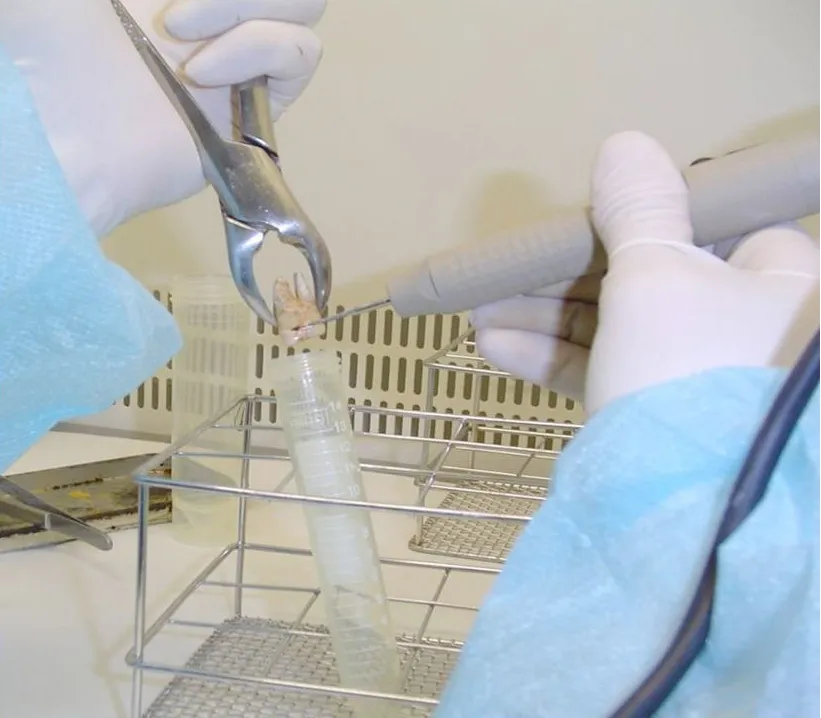
In 2007, Simón and his research group managed to extract the first fragment of S. mutans' DNA from the tooth of an ancient skeleton. In their new study, published today (July 22) in the journal Proceedings of the Royal Society B, the researchers examined S. mutans' DNA from 10 human skeletons. The skeletons came from both Europe and America. The oldest was from Bronze Age Europe, an era that began in 3200 B.C. and stretched until 600 B.C. The youngest dated to the 1900s. The American skeletons were chosen from both before and after Americans encountered Europeans, in case that event caused any changes in tooth decay bacteria.
Unrestrained evolution
The researchers analyzed only one fragment of the genome, a portion known to confer virulence, or the ability to cause disease, on the bacteria. Tracing the genetic mutations in the fragment over time, the researchers found that the bacteria evolved neutrally, Simón said.
Neutral evolution means that changes occur due to random genetic mutations that don’t confer any special advantages on an organism. The goal, Simón explained, was to see if factors such as the European invasion of North America put any pressure on S. mutans, causing it to evolve in one way or another. The discovery of neutral evolution suggests there were no particular pressures.
"It has to be taken into account that the amplified segment is very small," Simón said. "But it seems that this gene would not be among the ones that have been positively selected in order to improve S. mutans adaptation to the human host."
However, the toothache-causing bug did become more diverse over time. The bacteria seemed to have been able to diversify as their "testing ground" — humanity — became more numerous. Thus, instead of being limited to just a few variants, the bacterium could stretch its legs, try on some new mutations, and still survive.
Simón and his colleagues next plan to test more S. mutans' DNA samples, expanding their view beyond a single gene fragment and further into the genome. They hope to delve deeper into the moment of European and North American contact in search of any changes to the bacterium.
"Another goal will be to go further back in time, to the Neolithic period, to see if dietary changes provoked some kind of selection in this gene," Simón said.
Follow Stephanie Pappas on Twitter and Google+. Follow us @livescience, Facebook & Google+. Original article on Live Science.

Stephanie Pappas is a contributing writer for Live Science, covering topics ranging from geoscience to archaeology to the human brain and behavior. She was previously a senior writer for Live Science but is now a freelancer based in Denver, Colorado, and regularly contributes to Scientific American and The Monitor, the monthly magazine of the American Psychological Association. Stephanie received a bachelor's degree in psychology from the University of South Carolina and a graduate certificate in science communication from the University of California, Santa Cruz.