













Strong Earthquake Rattles Southern Mexico

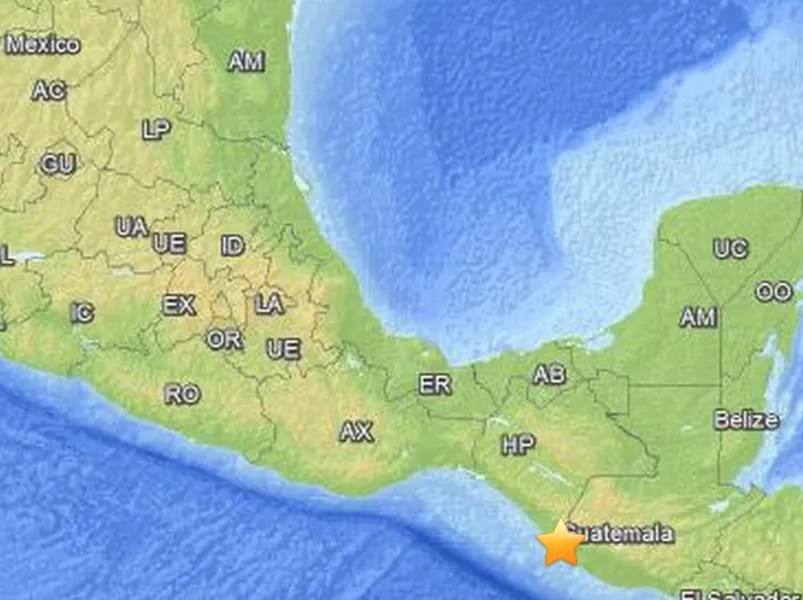
An earthquake of preliminary magnitude 7.1 struck today along the Pacific coast of southern Mexico's state of Chiapas, according to the U.S. Geological Survey (USGS).
The tremor, which was felt strongly in the immediate region, shook buildings and light posts as far away as Mexico City and caused power failures in western Guatemala, but there were no immediate reports of casualties or widespread damage, the Associated Press reported.
The quake's epicenter was 5 miles (8 kilometers) northeast of Puerto Madero, Mexico, and 124 miles (200 km) west of Guatemala City, Guatemala. It originated 57 miles (92 km) deep and struck at 6:23 a.m. local time (1123 UTC), the USGS reports.
Though earthquakes of this size can unleash significant damage, the destruction caused by any single seismic event depends of the geology of the region, building standards, and the quake's depth and proximity to cities. Earthquakes of this size also could generate local tsunamis, though officials with the Pacific Tsunami Warning Center (PTWC) said there was no threat of a widespread, destructive tsunami.
Mexico is one of the world's most seismically active regions because it sits atop the boundaries of several of Earth's tectonic plates.
Follow us @livescience, Facebook & Google+. Original article on Live Science.
Get the world’s most fascinating discoveries delivered straight to your inbox.
