Sounds Like ... Apes Play Charades

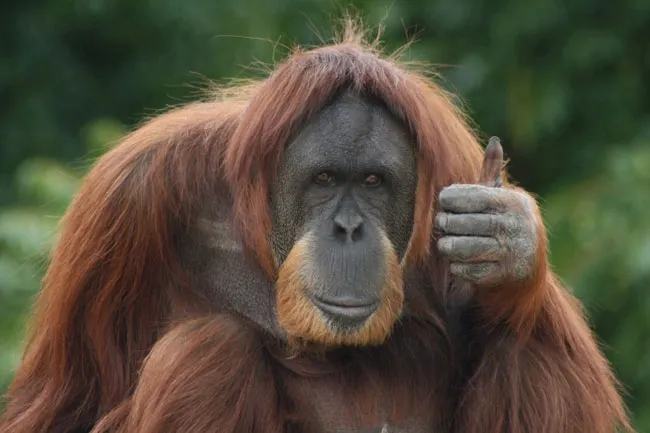
When humans play charades, the game's ban on talk often reduces players to wild gestures in a frustratingly minimalist form of communication. Still, skillful players get the point across eventually.
Apes can't talk at all, of course. But now scientists have found that orangutans rely on the same kinds of strategies seen in charades when they try and get their point across.
The finding hints at how the earliest forms of language might have developed among humanity's ancestors.
Ape the humans
Charades involves using only body language to act out a word or phrase that others must guess. When playing charades, people often repeat and hone gestures that have already worked and abandon ones that did not. This strategy not only improves a player's chances of picking effective gestures, but also gives hints to partners on how well or poorly they are doing.
To see how capable orangutans are of communicating with people via gestures, psychologists Erica Cartmill and Richard Byrne at the University of St. Andrews in Scotland presented six adult female orangutans in zoos a chance to essentially play charades.
The apes were shown one tempting food item, such as bananas or whole-grain bread, and one not-so-tempting food item, such as celery or leeks. The food could only be reached by signaling for human help, such as by pointing with fingers, blowing a "raspberry" or spitting through the bars.
Get the world’s most fascinating discoveries delivered straight to your inbox.
At times, the researchers purposefully misunderstood the orangutans' requests. Sometimes they provided only half of the delicious treat, while other times they handed over the unsavory alternative instead.
When people pretended not to comprehend what the apes' aims were, the creatures relied on the same basic strategy people follow in playing charades.
"The orangutans made a clear distinction between total misunderstanding, when they tended to give up on the signals they'd used already and use new, but equivalent, ones to get the idea across, and partial misunderstanding, when they tended to repeat the signals that had already partially worked, keeping at it with vigor," Cartmill said. "The response showed that the orangutan had intended a particular result, anticipated getting it and kept trying until it got the result."
Byrne noted that "looking at the tapes of the animal's responses, you can easily work out whether the orangutan thinks it has been fully, partially or not understood."
"In effect, they are passing information back to the audience about how well they are doing in understanding them—hence our 'charades' analogy," Byrne added. He and Cartmill detailed their findings Aug. 2 in the journal Current Biology.
Eager to play
Cartmill noted that the term "experiment" has gained an undeserved association with invasive or artificial studies." "The individuals I tested treated the experiment as a sort of game and eagerly approached me as I set up the equipment, hoping to succeed in winning the banana this time," she said.
Primate psychologist Anne Russon at York University in Toronto said these findings add weight "to the view that great apes—probably all of them [including orangutans]—can communicate intentionally and can do so well beyond basic levels."
Russon noted orangutans play a very important role in understanding the evolution of advanced communication because they are the "oldest" of the great apes, having diverged as a distinct species far earlier than any of the African great apes—12 to 15 million years ago versus 4 to 8 million years ago.
These findings "therefore make it very likely that the mental abilities which support this sophisticated intentional communication evolved when the earliest great apes evolved, some 12 to 15 million years ago," Russon said. "That is, they place the origins of intentional communication well prior to human evolution."
A charades-like strategy is one way to reach a mutual understanding regarding the meaning of certain sounds, gestures or symbols. This in turn could lead to a common vocabulary. These finding suggest "orangutans share more human capacities than previously thought," Byrne told LiveScience.
Cartmill said further investigation of ape communication might therefore shed light on the mechanisms humanity's ancestors used "in developing the earliest forms of language."
- VIDEO: Watch the Apes Play Charades
- VIDEO: Jane Goodall's Wild Chimpanzees
- 10 Amazing Things You Didn't Know About Animals