













Greenland Continues to Slip-Slide Away

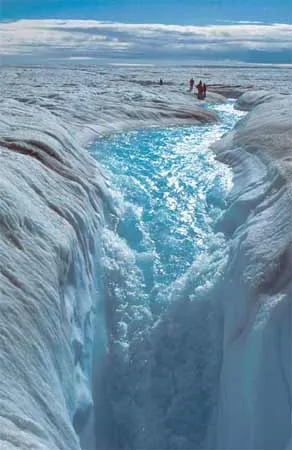
The icy mega-island of Greenland is slipping away faster than before, as it experienced more days of melting snow in 2006 than it does on average, new satellite observations show.
Satellite sensors taking daily observations of the ice since 1988 revealed that Greenland’s melting days have progressively increased and melting has increasingly taken place at higher altitudes.
“The sensors detected that snowmelt occurred more than 10 days longer than the average over certain areas of Greenland in 2006,” said study team leader Marco Tedesco, of the Joint Center for Earth Systems Technology, managed by the University of Maryland, Baltimore County, and NASA's Goddard Space Flight Center in Maryland.
Areas along Greenland’s western, southeastern and northeastern coasts witnessed the largest number of melt days in 2006.
More melting days could mean faster glacial flow and therefore more water pouring from the ice sheets into the ocean.
“The melting snow produces liquid water that will potentially influence sea levels,” Tedesco said. “And some of the liquid water will drain into glaciers through cracks and vertical passages, called moulins, reaching the bedrock below and lubricating the ice sheet.”
Previous studies have shown that melt water below ice sheets can speed their journey to the sea, where ice bergs calve, or break off, from the sheets, and potentially contribute to rising sea levels. A warming climate could ramp up the process even more.
Get the world’s most fascinating discoveries delivered straight to your inbox.
The melting could cause less of the sun’s radiation to bounce back into the atmosphere, because snow that melts and refreezes absorbs more sunlight than dry snow. If more radiation is absorbed, polar temperatures could rise even more than they have already and are predicted to continue doing as a result of global warming.
- Top 10 Surprising Results of Global Warming
- Video: Greatest Warming Seen at High Latitudes
- Images: Glaciers Before and After

Andrea Thompson is an associate editor at Scientific American, where she covers sustainability, energy and the environment. Prior to that, she was a senior writer covering climate science at Climate Central and a reporter and editor at Live Science, where she primarily covered Earth science and the environment. She holds a graduate degree in science health and environmental reporting from New York University, as well as a bachelor of science and and masters of science in atmospheric chemistry from the Georgia Institute of Technology.