















The Future of Glasses: Electronic Bifocals
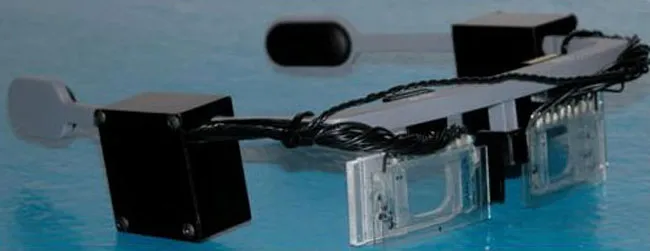
Don't throw away those bifocals just yet, but scientists have developed prototype spectacles that change prescriptions with the flick of a switch.
The new glasses could benefit people suffering from presbyopia, a condition in which faraway objects are in focus but those nearby appear blurry.
Presbyopia is a natural, age-associated progressive loss, and scientists estimate that about 90 percent of people over 45 suffer from it.
Many scientists believe presbyopia is caused by reduced elasticity of the eye's lens over time. Eventually the cornea—and other eye muscles that change lens shape to focus—can't overcome the lens' rigidity.
Doctors commonly prescribe bifocals, which have a small window on the bottom half to correct close-range vision. But bifocals can cause eye strain, a wearer has to constantly shift line of sight, and the field of vision is limited.
University of Arizona researcher Guoqiang Li and colleagues developed the potential improvement to Benjamin Franklin's invention.
Each lens consists of two flat glass plates with a hair-thin layer of shape-shifting liquid crystal sandwiched between. One of the plates is covered in small, transparent electrodes. When a current runs through the electrodes, it causes the liquid crystals to rearrange and mimic the nearby focusing power of a human eye lens.
Get the world’s most fascinating discoveries delivered straight to your inbox.
The transformation takes about a second.
"When it's on it has focusing power that can be used for reading," Li told LiveScience. "When it's off, it has no focusing power—it's just like a piece of glass—and can be used for driving and seeing far off things."
To make the change, users would flick a switch on a small battery pack that could attach to their belt or fit in a pocket. Li expects this setup to be commercially available in less than five years.
Eventually, the battery and switch could be incorporated into the glasses frame. The next step, Li said, would be to add sensors that would change the lens automatically, eliminating the need for a switch.
This research is detailed in the April 3 online edition of the Proceedings of the National Academy of Sciences.