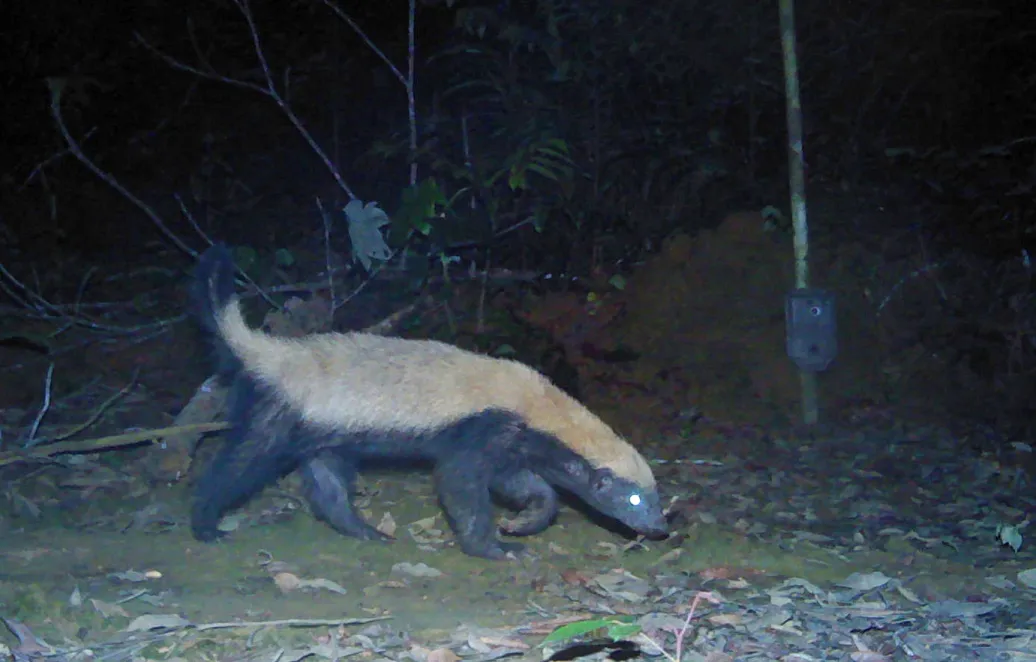
Gabon's wildlife includes viral video celebrity, the honey badger (Mellivora capensis), a small but tenacious hunter that's known to eat snakes, raid beehives and stand up to lions.
With charismatic lions and leopards often stealing the spotlight, small predators in Central Africa sometimes get overlooked.
But with the help of camera traps, researchers recently got a better look at the tiny carnivores that populate Gabon's forests, including mongooses, civets and the notoriously fearless honey badgers.
Among their findings, the researchers documented two of the carnivores for the first time in Gabon: the Cameroon cusimanse and the common slender mongoose. The Egyptian mongoose was also found 65 miles (105 kilometers) north of its previously known range.
The survey resulted in a range-extension for the Egyptian mongoose.
(Image credit: Laila Bahaa-el-din/Panthera)
The honey badger, meanwhile, had been considered rare in Gabon and the camera traps confirmed it has a patchy distribution in the country, recorded in just one region in central Gabon and one region on the coast.
"Many previous studies have focused on the larger species of Gabon's rainforests," study researcher Laila Bahaa-el-Din, of the conservation group Panthera, said in a statement. "None of these efforts have focused on the country-wide status and distribution of smaller predators, species that could be disappearing due to the bushmeat crisis sweeping through the region."
The bushmeat trade refers to the illegal capture and sale of wild animals for their meat. The practice has increased in parts of Africa due to population expansion and has imperiled animals like gorillas, bonobos and chimpanzees. While the small carnivore populations in Gabon appear to be healthy for now, conservationists worry that the animals could be increasingly targeted by the bushmeat trade in the future. Their survey could help establish a baseline for the predator populations in the wild.
Sign up for the Live Science daily newsletter now
Get the world’s most fascinating discoveries delivered straight to your inbox.
"It appears that these species are widespread and not currently threatened, but the proximity of many small carnivores to human settlements and the growing bushmeat trade could potentially impact these populations," study researcher Fiona Maisels, of the Wildlife Conservation Society, said in a statement. "These new findings will help inform future management."
The survey was part of a joint effort by Panthera, the Wildlife Conservation Society, the University of Stirling in Scotland, CENAREST and IRET in Gabon. It was detailed in the July edition of Small Carnivore Conservation.
Megan has been writing for Live Science and Space.com since 2012. Her interests range from archaeology to space exploration, and she has a bachelor's degree in English and art history from New York University. Megan spent two years as a reporter on the national desk at NewsCore. She has watched dinosaur auctions, witnessed rocket launches, licked ancient pottery sherds in Cyprus and flown in zero gravity. Follow her on Twitter and Google+.