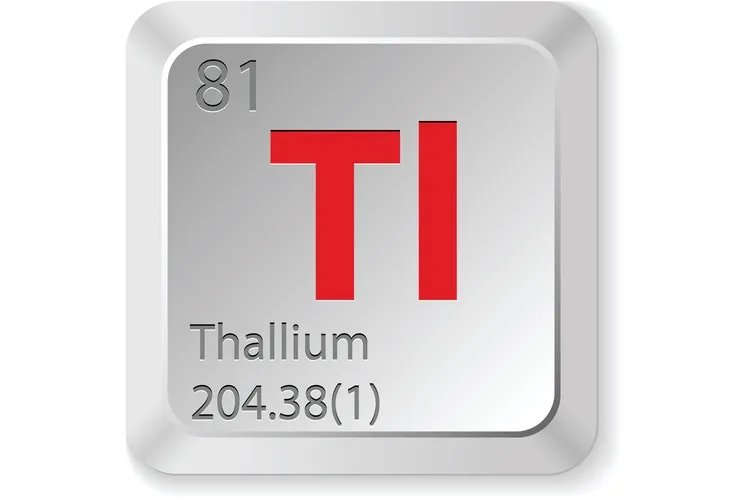
Atomic Number: 81 Atomic Symbol: Tl Atomic Weight: 204.38 Melting Point: 579.2 F (304 C) Boiling Point: 2,683.4 F (1,473 C)
Word origin: Thallium was named after the Greek word thallos, meaning green shoot or twig. It was named after its green spectral line.
Discovery: British chemist William Crookes discovered thallium spectroscopically in 1861. Both Crookes and French chemist Claude Auguste Lamy isolated the element in 1862 independently.
Latest Videos From
Properties of thallium
Thallium is a malleable, soft element that can be sliced with a knife. It has a metallic luster that quickly tarnishes when exposed to air to a bluish-green color.
Naturally occurring thallium is a mix of two isotopes. Twenty-five isotopic forms of thallium are recognized.
Thallium is a toxic metal and should not come into direct contact with skin. It’s also suspected as being carcinogenic.
Sources of thallium
Thallium is found as a mineral in the elements crooksite, lorandite and hutchinsonite. It’s also found as a trace element in iron pyrite and obtained from this ore by roasting the mineral. Small amounts of thallium are found in manganese nodules on the ocean floor.
Uses of thallium
Thallium is used in photoresistors, infrared optical equipment, low melting glasses and several other applications.
Thallium sulfate has been used as a rodent and ant killer because it’s odorless and tasteless. However, the use of the product has been prohibited since 1972 in the United States.
Thallium salts have also been used in the treatment of skin diseases, but the high rate of toxicity compared to the therapeutic benefits limited its medicinal applications.
(Source: Los Alamos National Laboratory)



 Live Science Plus


