














NASA Finds Blinking Baby Stars with Cosmic 'Hula Hoop'

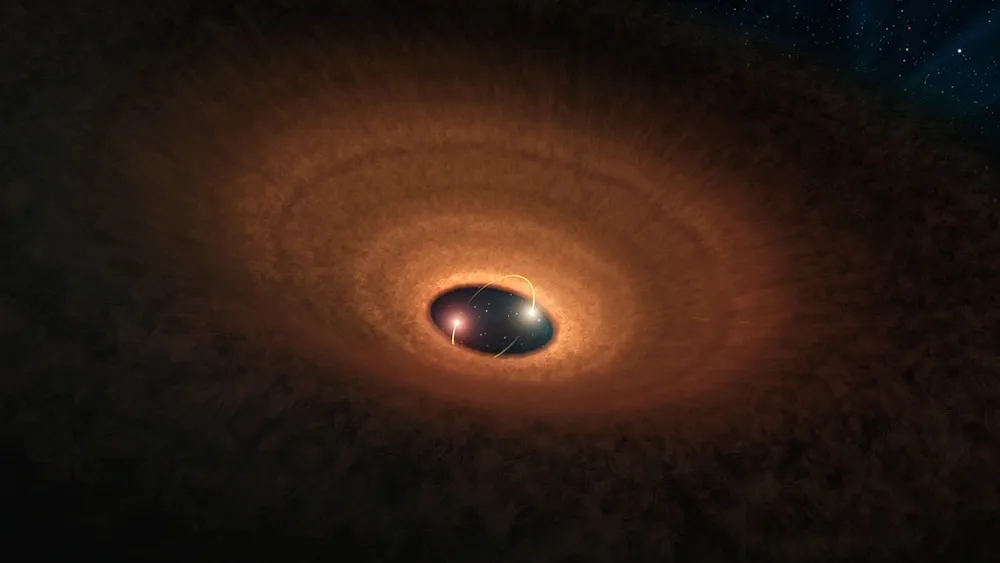
Astronomers using NASA's Spitzer Space Telescope have detected a system of young, blinking stars surrounded by a dusty "hula-hoop" of stellar leftovers that could form planets one day.
Dubbed YLW 16A, the three-star system cycles through bright and dim phases. The two main stars dancing around each other at the center occasionally peek out of the tilted disk that circles them, making the entire system seem to "blink" every 93 days, according to NASA.
Meanwhile, a third star orbits at the edge of the system outside of the cosmic hula-hoop. Its gravitational forces slightly distort this disk.
Scientists expect that the hoop, which is made up of leftovers from the star-formation process, will over time spawn planets and the other celestial bodies typically found in solar systems.
A planet that forms in this system could potentially be a circumbinary planet — one that orbits two stars. In that scenario, the alien world would be treated to a double sunset each night, much like the fictional planet "Tatooine" in Star Wars, NASA pointed out in its release.
The new findings, which have been accepted for publication in the journal Astronomy & Astrophysics, could shed light on the early stages of such planet formation.
"These blinking systems offer natural probes of the binary and circumbinary planet formation process," study researcher Peter Plavchan, a scientist at the NASA Exoplanet Science Institute and Infrared Processing and Analysis Center at the California Institute of Technology, Pasadena, Calif., said in a statement.
Get the world’s most fascinating discoveries delivered straight to your inbox.
By using Spitzer, astronomers detected infrared light emitted by the system's warmed gas and dusk in the disk. Their findings also drew from observations with the ground-based 2MASS survey and the European Southern Observatory's Very Large Telescope in Chile.
This story was provided by SPACE.com, a sister site to LiveScience. Follow Megan Gannon on Twitter and Google+. Follow us @Spacedotcom, Facebook or Google+. Originally published on SPACE.com.
