














Great White Mystery: Expedition to Unravel Shark Secrets

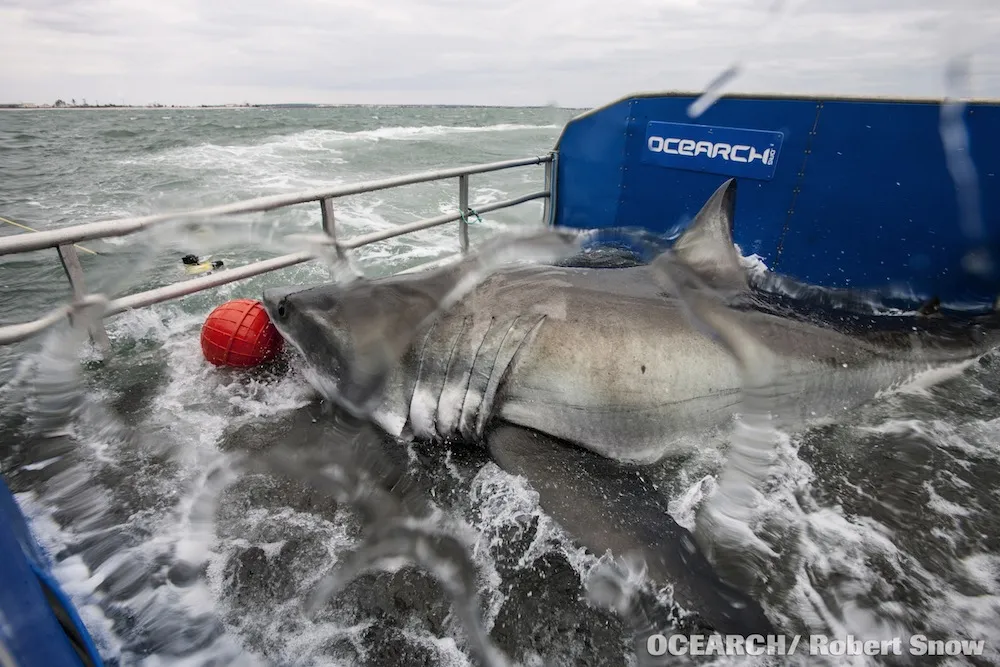
One of the most ambitious expeditions ever to tag great white sharks will set sail tomorrow (July 30) off Cape Cod, Mass. The researchers hope to tag as many as 20 of the enormous sharks, about which very little is known.
The project is expected to be the largest shark-tagging mission in U.S. history, according to the nonprofit shark research group OCEARCH, which is leading the mission along with the Woods Hole Oceanographic Institution (WHOI). The effort is part of an initiative to better understand the animals and to inform the public about the importance of sharks, which serve as top predators and are vital for the proper function of ocean food webs, said WHOI researcher Simon Thorrold. As many as 100 million sharks are killed per year due to both legal and illegal fishing, a recent study found.
"Given how much interest there is in great white sharks, we are still scientifically trying to find out the very basics," Thorrold said.
Tagging great whites
Aboard a vessel known as the M/V OCEARCH, researchers will cast lines for great white sharks, using barbless hooks designed to minimize harm to the animals, Thorrold said. After the shark is reeled in, a special platform powered by a hydraulic lift is then raised up underneath the shark, allowing scientists to attach a GPS tag to the animal's dorsal fin and perform a variety of tests on the animal, Thorrold told LiveScience's OurAmazingPlanet.
Scientists have to work quickly to minimize the stress they cause the sharks, Thorrold said. During the 15 minutes the researchers spend with each shark, the animal's gills are bathed in saltwater to prevent the shark from suffocating.
"It's like a NASCAR pit crew," Thorrold said. Perhaps surprisingly, the sharks don't seem to put up much of a fight, and "really chill out on the platform," he added.
Get the world’s most fascinating discoveries delivered straight to your inbox.
During the expedition, which runs from July 30 to Aug. 29, the scientists will take blood and tissue samples from each of the sharks they catch to learn more about the animals' health and diet. The GPS tags will allow scientists to see where the sharks are going, as well as the temperature of the water and the depths of their dives, Thorrold said.
Understanding sharks
Recent data derived from the tagging of great white sharks has shown that the animals follow two basic routes. Some of the sharks tend to stay along the East Coast and linger not far from the shore, Thorrold said. But others set out into the Atlantic Ocean, before making a wide circle and heading toward Bermuda. Previously, it wasn't known that sharks wandered far from shore, Thorrold said, adding, "That really blew our minds."
The data will be used in as many as a dozen studies and will help scientists understand the sharks' behaviors. More and more great white sharks have been spotted off Cape Cod in recent years — a development that has coincided with the rebound of populations of gray seals, upon which the sharks feed, Thorrold said.
Earlier this year, OCEARCH scientists tagged a shark named Lydia off the coast of Florida. Lydia and other sharks can be tracked at the Global Shark Tracker.
Email Douglas Main or follow him on Twitter or Google+. Follow us @OAPlanet, Facebook or Google+. Original article on LiveScience's OurAmazingPlanet.
