It's quick and easy to access Live Science Plus, simply enter your email below. We'll send you a confirmation and sign you up for our daily newsletter, keeping you up to date with the latest science news.
The oldest well-preserved skeleton of a primate, a 55-million-year-old specimen found in China, has been discovered, researchers report.
The primate appears to be the most primitive known relative of the group that contains tarsiers, small primates found only in Southeast Asia. The finding suggests this group diverged from anthropoids, the group that contains monkeys, apes and humans, during the Eocene epoch (55.8 million to 33.9 million years ago), a time of widespread warming.
It's not the oldest primate fossil, researchers say, but it is one of the oldest most-complete skeletons of the group known as tarsiiformes. [In Photos: A Game-Changing Primate Discovery]
"This discovery is really exciting," vertebrate paleontologist Jonathan Bloch of the University of Florida's museum of natural history told LiveScience, "because it shows us the first really [well-articulated] skeleton of one branch of the crown primate tree," (the group including all primates alive today and their common ancestor). Bloch was not involved in the study.
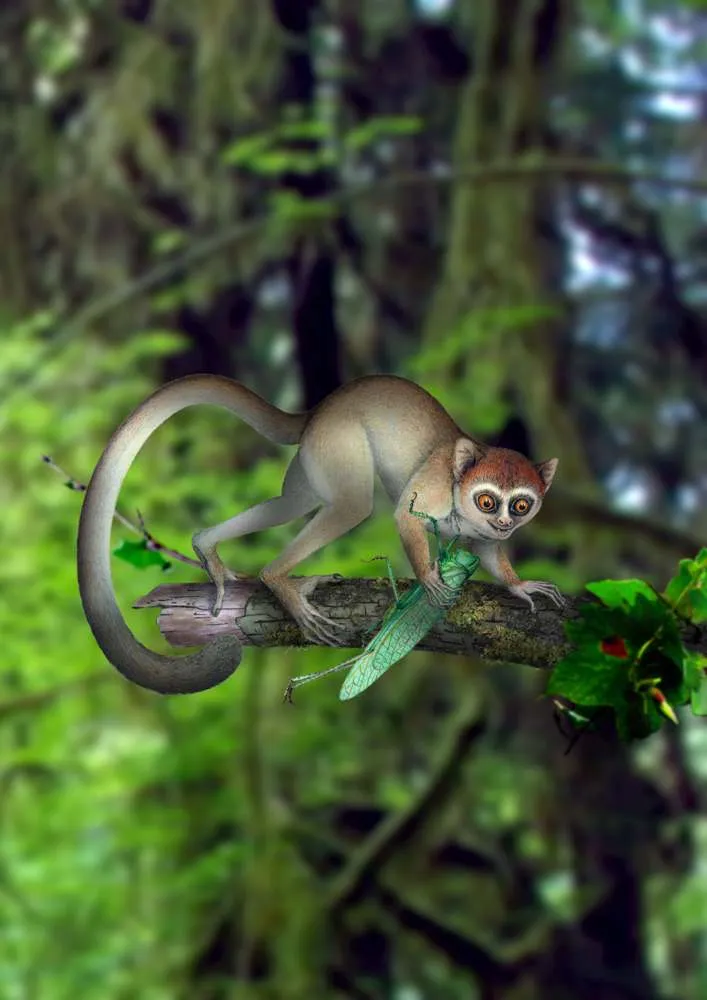
The fossil confirms speculation that the earliest primates probably lived in trees, ate insects and were active during the daytime.
The primate, now named Archicebus achilles (roughly translated as "ancient monkey"), would have weighed about 1 ounce (20-30 grams), suggesting the earliest primates were very small. The skeleton shares some features of tarsiers and some of anthropoids. For instance, the specimen's heel bone strongly resembles those of anthropoids, hence the species name, "achilles."
Illustration of an evolutionary tree, showing how Archicebus fits with respect to primate phylogeny.
(Image credit: Mark A. Klingler/Carnegie Museum)
According to the researchers, this fossil and other evidence suggest the first steps of primate evolution took place in Asia, rather than Africa. But Bloch and others disagree with this interpretation.
Sign up for the Live Science daily newsletter now
Get the world’s most fascinating discoveries delivered straight to your inbox.
"Crown primates appeared simultaneously in North America, Europe and Asia 56 million years ago," Bloch said. "I don't think this specimen tells us much about where primates themselves evolved," he added.
The fossil was dug up from an old lake bed in central China's Hubei Province, close to where the Yangtze River now flows.
The fossil was scanned with X-rays at the European Synchrotron Radiation Facility (ESRF) in Grenoble, France, to produce a 3D digital reconstruction without damaging the specimen.
The Archicebus skeleton is roughly 7 million years older than the previously known oldest fossil primate skeletons, which include Darwinius from Messel, Germany, and Notharctus from the Bridger Basin, Wyoming.
Archicebus is not the oldest primate, anthropologist Mary Silcox of the University of Toronto Scarborough, Canada, told LiveScience. Nevertheless, "this new species will significantly impact our understanding of what is primitive for the common ancestor of living primates," Silcox said.
The findings were reported online today (June 5) in the journal Nature.
Tanya was a staff writer for Live Science from 2013 to 2015, covering a wide array of topics, ranging from neuroscience to robotics to strange/cute animals. She received a graduate certificate in science communication from the University of California, Santa Cruz, and a bachelor of science in biomedical engineering from Brown University. She has previously written for Science News, Wired, The Santa Cruz Sentinel, the radio show Big Picture Science and other places. Tanya has lived on a tropical island, witnessed volcanic eruptions and flown in zero gravity (without losing her lunch!). To find out what her latest project is, you can visit her website.

 Live Science Plus