















Caterpillar Defense: 'Freeze and Drop'
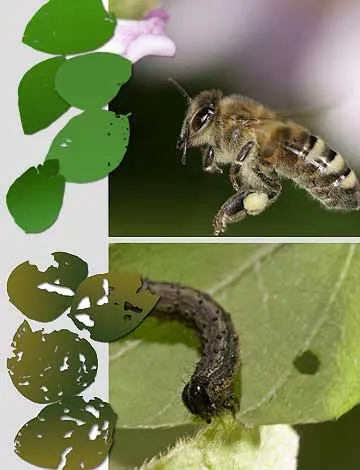
Even a novice naturalist can tell a bee from a wasp. So shouldn't caterpillars, which are unharmed by the former but destroyed by the latter, be able to do so too? Apparently not.
Researchers at the University of Würzburg in Germany discovered that the beet armyworm, an infamous crop pest, displays the same defensive behavior toward bees as it does toward wasps. In fact, the mere presence of bees deters armyworms from munching leaves. Armyworms, like many caterpillars, have sensory hairs near their heads that detect air vibrations stirred by wasps' wings. When a wasp approaches, an alerted caterpillar freezes and drops off the plant. Thus, depending on the wasp species, it avoids being eaten or receiving an injection of wasp eggs into its body. Aware that bees' wingbeat frequency is similar to wasps', Jürgen Tautz and Michael Rostás studied the behavior of beet armyworms inside tents containing crop plants as well as bee feeders filled with sugar water. Bees could access only half the tents, and the researchers found that the caterpillars there ate 60 to 70 percent less leaf area than in the "silent" tents. Energy wasted by dropping in response to a harmless bee is apparently well spent to avoid the possibility of becoming a wasp lunch or nursery. As for the plants, they were the unmistakable winners. Conceivably, interspersing insect-pollinated plants with crops could generate some positive buzz in pest control.
The research was detailed in the journal Current Biology.
Get the world’s most fascinating discoveries delivered straight to your inbox.