














Why Dogs Chase Laser Beams (and Why It Can Drive Them Nuts)

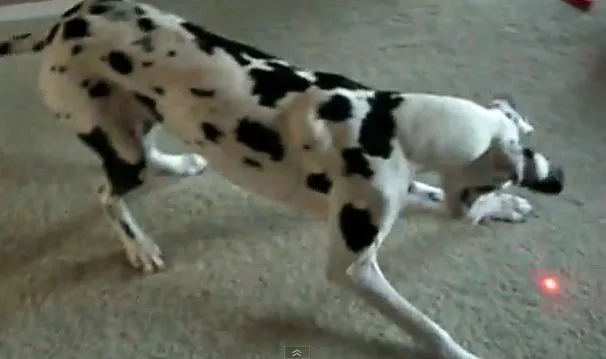
When a wiggly little bead of light catches a dog's eye, nothing in the world matters more than capturing it. Unfortunately, "it" is just an ungraspable bundle of massless photons. The lack of closure in laser-beam chasing could be messing with your dog's head.
Dogs (and some cats) instinctively chase these bright-red dots simply because the dots move, said Nicholas Dodman, a professor of animal behavior at Tufts University's Cummings School of Veterinary Medicine. Movement automatically stimulates their innate prey drive, which explains why lower-on-the-food-chain animals such as rodents and rabbits often freeze in place as a survival strategy. Although dogs aren't so discerning when it comes to color, their eyes contain a high preponderance of light-sensitive cells called rods for top-notch motion detection.
A laser beam's incessant movement keys into this predatory system. "They can't help themselves; they are obliged to chase it," Dodman told Life's Little Mysteries.
But should you really be stimulating your dog's prey drive when it won't ever lead to triumph — the catching of light? Probably not such a good idea. "They can get so wound up and driven with prey drive that once they start chasing the light they can't stop. It becomes a behavior problem," Dodman said. "I've seen light chasing as a pathology where they will just constantly chase around a light or shadow and pounce upon it. They just spend their whole lives wishing and waiting." [How Did Dogs Get to Be Dogs?]
Never getting a reward for their vigilance "makes dogs loopy," he explained. Along the same lines, trainers of bomb- and drug-sniffing dogs have found that their dogs become psychologically disturbed if they never find bombs or drugs, so they must occasionally be taken on dummy missions.
For pets who love to chase, more tangible toys pose a solution. Dodman recommends "Talk to Me Treat Ball" products, a line of motion-activated balls that play owner-recorded messages and kick out food treats through slits as the dog plays. "It's about as near to real prey as you can get, other than tipping open a box of mice in your living room," he said.
If you insist on dancing a laser beam across the floor instead, one option is to hide treats in nooks and crannies around the room, and occasionally surprise your pet by landing the light upon them.
Get the world’s most fascinating discoveries delivered straight to your inbox.
Follow Natalie Wolchover on Twitter @nattyover or Life's Little Mysteries @llmysteries. We're also on Facebook & Google+.

Natalie Wolchover was a staff writer for Live Science from 2010 to 2012 and is currently a senior physics writer and editor for Quanta Magazine. She holds a bachelor's degree in physics from Tufts University and has studied physics at the University of California, Berkeley. Along with the staff of Quanta, Wolchover won the 2022 Pulitzer Prize for explanatory writing for her work on the building of the James Webb Space Telescope. Her work has also appeared in the The Best American Science and Nature Writing and The Best Writing on Mathematics, Nature, The New Yorker and Popular Science. She was the 2016 winner of the Evert Clark/Seth Payne Award, an annual prize for young science journalists, as well as the winner of the 2017 Science Communication Award for the American Institute of Physics.