













What Would Earth Be Like with Two Suns?

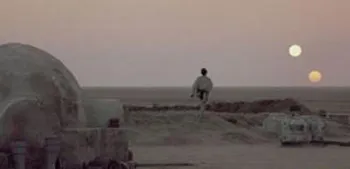
Astronomers have just discovered the first "circumbinary planet." Like Luke Skywalker's home planet of Tatooine in the "Star Wars" films, this strange world, labeled Kepler-16b, orbits two closely spaced suns.
What would such a planet be like? For that matter, what if Earth had two suns instead of one? Alan Boss, an astrophysicist at the Carnegie Institution for Science in Washington, D.C., is a member of the Kepler-16b discovery team. He describes the scenery on the Tatooine-like planet, and how Earth would fare in such a binary star system. [6 Everyday Things that Happen Strangely in Space ]
First off, on Kepler-16b "it's a little frosty," Boss said. "Though it is closer to its stars than Earth is to the sun, the stars aren't quite so bright, so the temperature of this planet would only be about 200 Kelvin," or nearly minus-100 Fahrenheit.
Earth would be even chillier under the same stellar circumstances. "If you replaced our sun with those stars, we would be even colder than 200 Kelvin, because we're farther out than this Tatooine-like planet," he told Life's Little Mysteries.
In such a frigid environment, all Earth's water would be frozen, and Boss strongly doubts life would have arisen here. Earth under two suns "is not a habitable planet unless you had an advanced life form that originated elsewhere that could keep itself warm."
Orbiting these two stars, Earth's year would be longer than 365 days, he said, but not by much: "One star in the [Kepler] binary system has a mass 20 percent of the mass of the sun, and the other is 70 percent the mass of the sun. Together their masses only differ from our sun by 10 percent. This would make the year on Earth slightly longer, because the gravity of the stars pulling us inward would be lower, so there's less centrifugal force and we would orbit around slower," Boss said.
The length of a day on our planet wouldn't necessarily change, as long as our moon had still formed and its orbit stayed the same, he said.
Get the world’s most fascinating discoveries delivered straight to your inbox.
Would the moon stay the same? No telling no one knows what process causes the formation of circumbinary planets and their satellites. "We don't really have a good feeling of how a planet would form around these two stars. Theorists don't really know how that would happen," Boss said. "But now we know that the answer is yes, it can happen." [China's 'Two Suns' Video Unexplained By Science ]
Perhaps the best aspect of a circumbinary planet would be the view. Boss said the sunset on Kepler-16b or a circumbinary Earth would look very much like the fictional Tatooine sunset in "Star Wars IV: A New Hope." "In that film, Luke looks up and sees the two stars setting. They would not be quite so large in the sky as in the film, but you would see two differently colored stars close together without touching.
"So the 'Star Wars' image is not that far off."
- 6 Everyday Things that Happen Strangely in Space
- A Field Guide to Alien Planets
- Alien Hunters to Search New Super-Earths for Life
Follow Natalie Wolchover on Twitter @nattyover. Follow Life's Little Mysteries on Twitter @llmysteries, then join us on Facebook.

Natalie Wolchover was a staff writer for Live Science from 2010 to 2012 and is currently a senior physics writer and editor for Quanta Magazine. She holds a bachelor's degree in physics from Tufts University and has studied physics at the University of California, Berkeley. Along with the staff of Quanta, Wolchover won the 2022 Pulitzer Prize for explanatory writing for her work on the building of the James Webb Space Telescope. Her work has also appeared in the The Best American Science and Nature Writing and The Best Writing on Mathematics, Nature, The New Yorker and Popular Science. She was the 2016 winner of the Evert Clark/Seth Payne Award, an annual prize for young science journalists, as well as the winner of the 2017 Science Communication Award for the American Institute of Physics.