The devastating earthquake that struck Japan earlier this year was powerful enough to slightly alter the pull of gravity under the affected area, scientists now find.
Anything that has mass has a gravity field that attracts objects toward it. The strength of this field depends on a body's mass. Since the Earth's mass is not spread out evenly, this means its gravity field is stronger in some places and weaker in others .
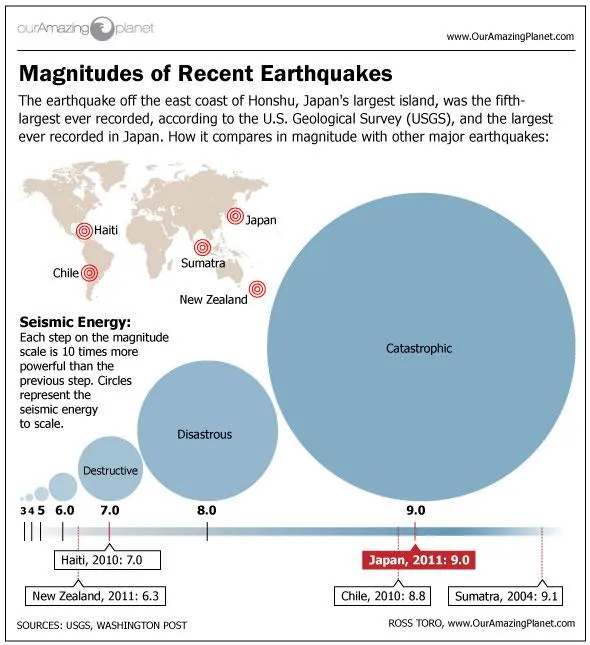
The magnitude 9.0 Tohoku-Oki temblor in March was the most powerful earthquake to hit Japan and the fifth-most powerful quake ever recorded . To see how the temblor might have deformed the Earth there, scientists used the Gravity Recovery and Climate Experiment (GRACE) satellites to analyze the area's gravity field before and after the quake.
The researchers found the Tohoku-Oki quake reduced the gravity field there by an average of two- millionths of a gal by slightly thinning the Earth's crust. In comparison, the strength of the gravitational pull at the Earth's surface is, on average, 980 gals. (The gal, short for Galileo, is a unit of acceleration; one gal is defined as one centimeter per second squared.)
"The most important implication of our findings is that the massive Tohoku-Oki earthquake brings significant changes to not only the ground but also the underground structure of Japan," researcher Koji Matsuo, a geophysicist at Hokkaido University in Japan, told OurAmazingPlanet.
The GRACE satellites had previously detected gravity changes caused by the magnitude 9.1 to 9.3 2004 Sumatra-Andaman quake, the third-most powerful earthquake ever recorded, and the magnitude 8.8 earthquake that hit Chile in 2010, the eighth-most powerful on record. These reduced the gravity fields in the areas struck in much the same way as the Tohoku-Oki quake, since they were all similar types of earthquakes.
The researchers are now interested in seeing if they can detect post-quake gravity field changes as the crust settles back into place.
Sign up for the Live Science daily newsletter now
Get the world’s most fascinating discoveries delivered straight to your inbox.
Matsuo and his colleague Kosuke Heki detailed their findings online Sept. 22 in the journal Geophysical Research Letters.
Charles Q. Choi is a contributing writer for Live Science and Space.com. He covers all things human origins and astronomy as well as physics, animals and general science topics. Charles has a Master of Arts degree from the University of Missouri-Columbia, School of Journalism and a Bachelor of Arts degree from the University of South Florida. Charles has visited every continent on Earth, drinking rancid yak butter tea in Lhasa, snorkeling with sea lions in the Galapagos and even climbing an iceberg in Antarctica.